The reference process for appearance and large-size plastic parts
Vacuum thermoforming is the most widely used thermoforming technique in industry. It is the technique that forms the heart of our thermoformed part production and also the one for which we have the greatest mastery with over 50 years of experience.
What is vacuum thermoforming?
Vacuum thermoforming consists of heating a thermoplastic sheet or plate to its softening temperature, then creating a depression between the sheet and the mould. This suction presses the material against the surface of the tooling with precision and uniformity. Once cooled, the part retains the shape of the mould and can be demoulded, trimmed and machined according to the specifications of the brief.
The depression plays a key role in the quality of the final result. It ensures homogeneous contact between the material and the mould across the entire surface and guarantees compliance with dimensions, details and curves. This avoids zones with irregular thicknesses that can appear with other shaping processes.
The advantages of vacuum thermoforming for industrials
Controlled tooling cost
Moulds for vacuum thermoforming are significantly less expensive than plastic injection tooling. A machined aluminium mould or epoxy resin mould represents an accessible investment from the very first tens of parts, which makes this process particularly relevant for small runs, evolving productions and projects requiring several variants.
For large-dimension parts
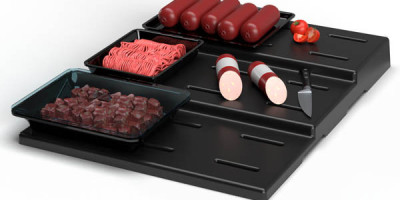
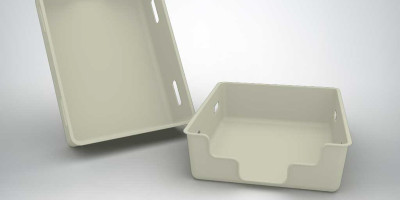
Vacuum thermoforming allows very large-format parts to be produced, something plastic injection cannot achieve within the same budget. Machine cladding, protective panels, industrial trays or large-size covers are produced at Plastisart with dimensions reaching several metres for certain projects.
Surface finish faithful to the mould
The surface of the mould allows different textures to be achieved on parts. For example, a polished mould surface gives a glossy part, while a sandblasted mould gives a matt or grained result. This mastery of surface finish is particularly useful for appearance parts intended to be visible on the final product.
Fast production launch and shorter lead times
Between the validation of the manufacturing file and the delivery of the first parts, lead times are significantly shorter than with plastic injection. The manufacture of vacuum thermoforming tooling is faster, and any adjustments during the project can be made to an aluminium mould without starting from new tooling.

Two different part typologies
Vacuum thermoforming applies to two types of parts depending on the thickness of the starting plastic sheet or plate.
Thin gauge (below 2 mm)
Often used for lighter parts, protective shells, trays and components with a simple geometry that do not require high-cadence production.
Thick gauge (above 2 mm and up to more than 10 mm depending on materials)
This is the thickness that Plastisart masters most for the production of technical industrial parts such as machine covers, robot cladding, protective structures and medical equipment components. With our experience, we have mastered zone heating, material shrinkage management and above all compliance with the dimensions specified in the design drawings.
Our materials suited to vacuum thermoforming
Not all thermoplastics are thermoformable. At Plastisart, we vacuum thermoform the following materials according to your project requirements:
The choice of materials is defined according to your needs by our design office, taking into account the necessary mechanical properties, operating conditions, finish requirements and sector constraints.
Complementary machining is necessary
A vacuum thermoformed part is rarely a finished part when it leaves the mould. It generally requires trimming to remove the excess material around the contour, as well as drilling, milling and precision machining to create the assembly interfaces defined in the manufacturing file. Our CNC 3 and 5-axis machining centres allow these operations to be carried out with precision, directly in continuity with thermoforming, without changing partners.
Our different areas of application
Industrial Sector
Machine guards, equipment protections and structural parts for demanding industrial environments.
Medical & Health Sector
Covers, protections and transparent parts for medical equipment in cleanrooms or operating theatres.
Aerospace & Defense Sector
Canopies, optical curves and lightweight parts for aeronautical and defence applications.
Automotive & Transport Sector
Windscreens for special vehicles, cabin glazing and visual protections for transport equipment.
Agri-food Sector
Parts in food-grade materials (PETG, PMMA) adapted to hygiene and cleaning requirements.
Communication & Events Sector
Displays, domes and curved visual elements for stands, exhibitions and event signage.
Cosmetics Sector
Curved aesthetic parts for premium packaging and presentation displays.
Office & Business Sector
Protections, dividers and ergonomic curved parts for office furniture and equipment.
Building & Construction Sector
Architectural curves, glazing and decorative plastic elements for the construction sector.
Energy & Environment Sector
Curved covers and protections for energy installations and environmental equipment.
Sports & Leisure Sector
Transparent or tinted parts for sports equipment, leisure vehicles and visual protections.
Why choose Plastisart for vacuum thermoforming?
Precision, responsiveness and savings on tooling
Vacuum thermoforming is a process that allows design flexibility and superior surface quality with an unbeatable price-quality ratio. At Plastisart, it is integrated into a complete offering that goes from mould design to the delivery of the finished, machined and inspected part.
FAQ
What is the difference between vacuum thermoforming and pressure thermoforming?
These two processes are complementary, not competing. Vacuum thermoforming uses only depression to form the material: it is the most accessible process, with the lowest tooling costs. It is ideal for large surfaces, appearance parts and moderately deep geometries.
Pressure thermoforming adds compressed air overpressure on the opposite side to the depression, which allows finer details, sharper angles and better thickness distribution on parts with complex geometry or deep draw. The tooling cost is slightly higher, but the precision achieved is greater.
Can a matt, glossy or grained appearance be obtained directly from the mould?
Yes, absolutely. The plastic faithfully follows the surface condition of the tooling under the effect of the vacuum. A polished mould will give a glossy part, while a sandblasted or textured mould will directly transmit a matt or grained result to your component. This avoids the painting step for many appearance parts.
What are the production launch lead times compared to plastic injection?
Lead times are considerably shorter. The design and machining of a vacuum thermoforming mould in resin or aluminium requires far less time than a steel injection mould. You therefore receive your first series parts much faster, and tooling modifications during the project remain simple and agile.
Do parts come out ready to use once thermoformed?
No, a raw thermoformed part always requires a finishing step. When it leaves the mould, it is surrounded by excess material. We use our CNC 3 and 5-axis machining centres to carry out precise trimming of contours, as well as the drilling, windows and milling operations indispensable for the assembly of your part.