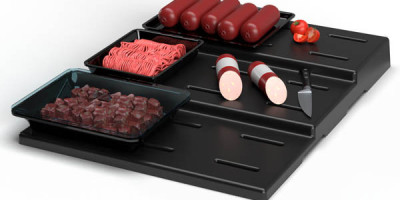
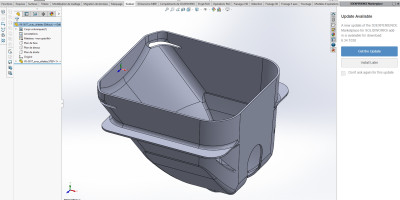
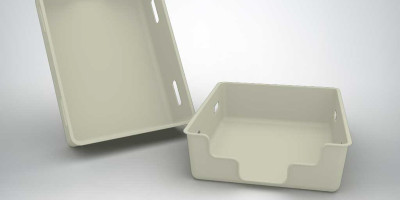
High-impact PS is one of the most economical standard thermoplastics in industry. Recognised for its rigidity, ease of processing and excellent surface finish, it is the material of choice for appearance parts, display units and technical components produced in mid-range volumes.
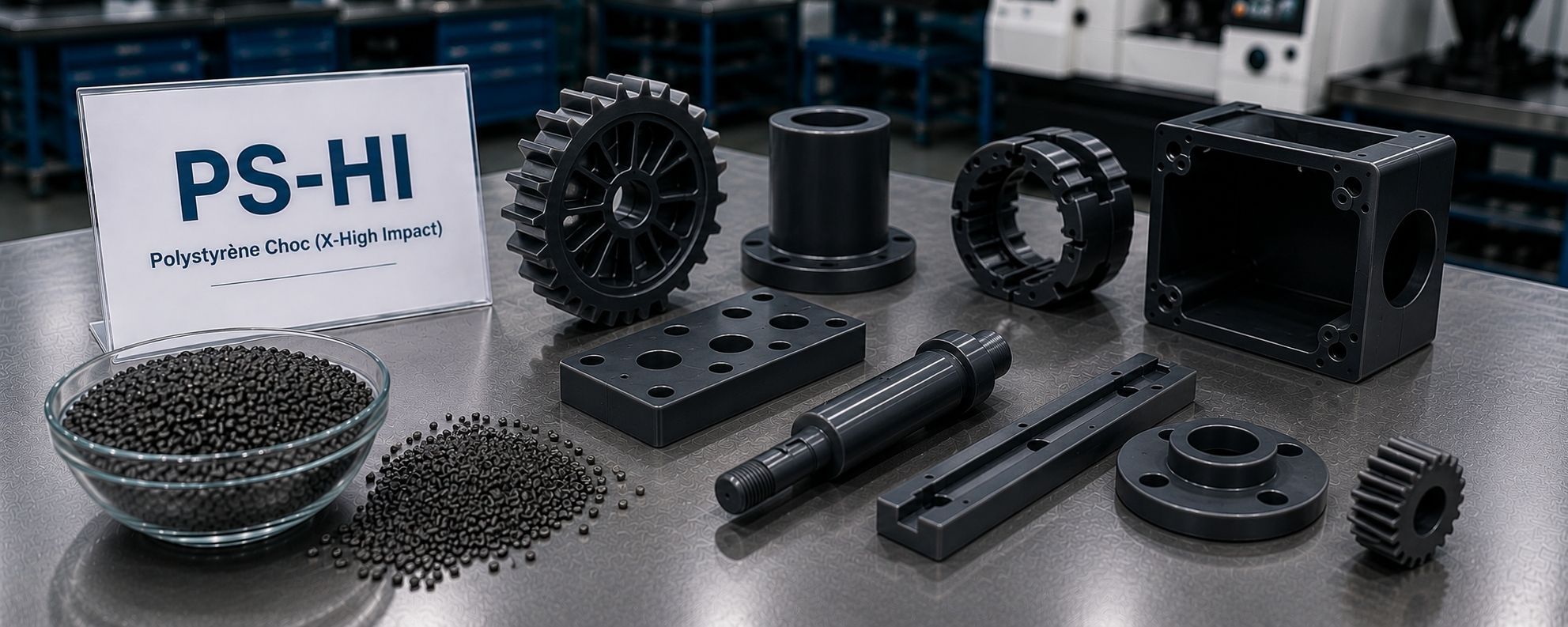
The pinnacle of thermoplastics
- Comprehensive support, from design to industrialization
- Detailed identification of your technical needs
- Advice on the choice of the most suitable technologies
What is PS plastic?
Polystyrene (PS) is a vinyl thermoplastic polymer. On the industrial market, two main families coexist depending on mechanical requirements:
- Crystal PS (GPPS): rigid and transparent in its natural state, it offers an excellent surface finish and good dimensional precision, but remains brittle under impact.
- High-impact PS (HIPS): modified by the addition of rubber (polybutadiene), it gains significantly higher impact resistance while retaining good rigidity, at the cost of an opaque appearance.
The main properties and advantages of PS
High-impact PS is particularly valued for appearance parts produced in mid-range volumes, thanks to a highly competitive quality/cost ratio:
- Mechanical properties: good rigidity, high surface hardness and satisfactory dimensional stability for non-structural parts.
- Thermal properties: it withstands service temperatures up to approximately 70 °C to 80 °C continuously.
- Aesthetic properties: it offers an excellent surface finish, good printability and markability, as well as a wide range of mass-coloured shades.
- Economic advantage: it is one of the most accessible thermoplastics on the market, particularly suited to parts not subject to significant mechanical stress.
The limitations of PS: which applications should it be avoided for?
As experts, it is our duty to guide you towards the right material. PS has certain limitations to be aware of:
- UV sensitivity: PS tends to yellow and weaken if exposed to sunlight for extended periods. For prolonged outdoor use, we will direct you towards a UV-stabilised grade or a more suitable thermoplastic.
- Low solvent and grease resistance: it is sensitive to strong solvents, oils and certain fats, which can cause stress cracking (crazing).
- Limited impact resistance for crystal PS: the transparent version remains brittle. For applications subject to impact, we systematically direct towards high-impact PS or another technical material.
How does Plastisart process PS?
PS has the advantage of being an easy plastic to process within short lead times. At Plastisart, we work with it daily through different processes:
- Vacuum thermoforming: high-impact PS is one of the most widely used plastics in thermoforming. It stretches homogeneously, faithfully reproduces mould details and shows low and predictable shrinkage on cooling.
- CNC machining: it is easily milled, turned and drilled. It generates clean chips and allows precise dimensional tolerances to be achieved for prototypes and small series.
- Hot bending: PS bends well for producing simple housings or display units without requiring a mould.
- Assembly and finishing: it is a plastic that bonds well with suitable adhesives and readily accepts painting, marking and screen printing.
Industry sectors and typical industrial applications
Thanks to its excellent surface finish and controlled cost, PS is found in many sectors for the manufacture of:
- Display units, totems and indoor signage structures
- Housings and claddings for household appliances and consumer electronics
- Trays and technical non-food packaging parts
- Mock-ups, prototypes and pre-series parts
- Appearance parts for furniture and fittings
Industrial sector
Control housings, lightweight covers and appearance parts for industrial equipment in small and medium series.
Medical & pharmaceutical sector
Trays, jigs and non-critical appearance parts in PS for laboratory environments and medical offices.
Aerospace & defence sector
Mock-ups, inspection jigs and prototypes in PS for rapid geometry validation before final production.
Transport & mobility sector
Lightweight interior cladding parts and functional prototypes in PS for design validation before series production.
Food processing sector
Trays and technical packaging parts for non-food products in PS for secondary packaging and presentation.
Communication & events sector
Display units, totems and signage structures in PS with painted or screen-printed finishes in your brand colours.
Cosmetics sector
Display units and aesthetic claddings in PS with refined finishes for showcasing products in store.
Office sector
Housings, fascias and appearance parts in PS for office equipment and fitting furniture.
Building & construction sector
Architectural mock-ups, presentation jigs and appearance parts in PS for indoor demonstrations.
Energy & environment sector
Housings and appearance parts not exposed to weathering for indoor measurement and control equipment.
Sports & leisure sector
Display units, trophies and appearance parts in PS for sports equipment and indoor structures.
Why choose Plastisart for your PS parts?
Processing PS requires good mastery of thermoforming to preserve its surface finish and anticipate its cooling behaviour. At Plastisart, you benefit from a permanent stock of high-impact PS sheets (various thicknesses and shades) for maximum responsiveness on your lead times. Our integrated design office validates your drawings and delivers complete finished parts and sub-assemblies, ready to use, at a particularly competitive material cost.
FAQ about PS
What is the difference between crystal PS and high-impact PS?
Crystal PS (GPPS) is rigid and transparent, but brittle under the slightest impact. High-impact PS (HIPS) is modified by the addition of rubber, making it opaque but significantly more resistant to impacts. For the vast majority of our industrial applications, we work with high-impact PS, more versatile and more reliable in use.
Can a PS part be painted or screen-printed?
Yes, PS offers excellent adhesion to industrial paints, varnishes and inks. It is one of the simplest thermoplastics to finish if your part requires marking, screen printing or coating in your brand's colours.
Is PS recyclable?
Yes, PS is a recyclable thermoplastic. The machining off-cuts and trimming waste generated in our workshops are ground up and reintegrated into new production cycles, limiting material waste on your projects.