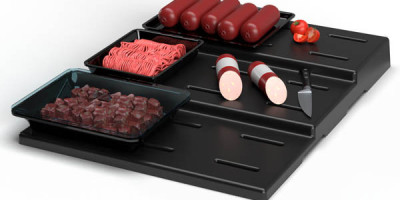
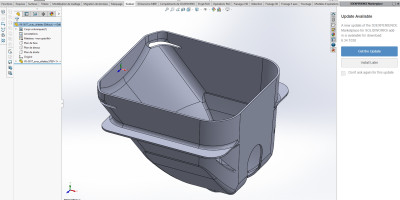
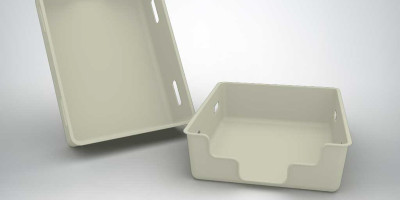
Plastisart is a manufacturer of custom thermoformed parts for various sectors.
Plastic thermoforming is a historic process at Plastisart. For over 50 years, we have been designing and manufacturing thermoformed parts for industrials who need precise, repeatable plastic components delivered within controlled lead times, whether for a few parts or larger quantities.
This long experience, accumulated over thousands of projects in sectors as varied as industrial machinery, medical, transport and food processing, has allowed us to develop a refined mastery of thermoforming and an in-depth knowledge of material behaviour according to forming temperatures, tooling design, and the ability to combine thermoforming and CNC machining on the same part to achieve levels of precision that thermoforming alone does not always allow.
What is plastic thermoforming?
Plastic thermoforming is a shaping process that consists of heating a thermoplastic sheet or plate to its softening temperature, then giving it its final shape by application onto a mould. The part retains its shape once cooled. The mould can be positive or negative depending on the desired geometry and surface finish requirements.
The principle may seem simple, but its industrial implementation requires mastery of many parameters:
- The temperature and homogeneity of heating
- The speed and pressure of forming
- The geometry and material of the mould used
- The management of material shrinkage according to the thermoplastic used
Professional plastic thermoforming makes it possible to produce parts with stable and repeatable dimensions from one series to the next, and above all with surface finishes adapted to the final application.

The different thermoforming processes at Plastisart
Vacuum thermoforming
Vacuum thermoforming is our most common process. It consists of pressing a thermoplastic sheet against a mould by suction to create a depression and ensure uniform contact between the material and the mould. This technique offers an excellent balance between forming quality and tooling cost.
Pressure thermoforming
This technique consists of applying overpressure on the material sheet to replace vacuum suction. This makes it possible to obtain finer details, sharper angles and better thickness distribution. It is a technique particularly suited to more technical parts with tighter tolerances.
Bubble forming
Before application onto a mould, the heated thermoplastic sheet can be pre-stretched by air injection to form a bubble, in order to guarantee a more homogeneous thickness distribution on deep parts. This step reduces localised thinning in high-draw zones.
Production possibilities in plastic thermoforming
Large-dimension parts
Thermoforming is one of the few plastic processes that allows the production of very large-format parts at reasonable tooling costs. Our thermoforming machines are adapted for processing large-dimension sheets, which allows us to produce covers, machine cladding, protective panels and envelope structures that plastic injection cannot achieve at reasonable costs.
Small and medium runs
The tooling cost of plastic thermoforming is significantly lower than that of plastic injection. An aluminium or resin mould represents a far more accessible investment than a steel injection mould, which makes thermoforming competitive from the very first tens of parts. This is one of the main advantages for industrials who manage modest volumes or evolving series.
In-house tooling
Our thermoforming moulds are designed and manufactured directly in our integrated mechanical workshop. Resin moulds for prototyping and very small runs, aluminium moulds with cooling systems for longer runs: the choice of tooling material is adapted to the volumes and dimensional requirements of each project. This in-house manufacturing allows controlled lead times and rapid modifications if necessary.
Post-thermoforming machining
A thermoformed part is not necessarily a finished part. Our 3 and 5-axis machining centres allow trimming, drilling, milling and precision machining operations to be carried out on each part to achieve the final dimensions and assembly interfaces defined in your specifications. This combination of thermoforming and machining is one of our specialities: it allows complex parts to be obtained at a cost that neither thermoforming alone nor machining alone would allow.
Our available materials for plastic thermoforming
We thermoform a wide range of thermoplastics, selected according to the mechanical, thermal and chemical properties required by the final application:
- ABS
- ABS/PMMA
- ABS/PC
- PEHD
- PP
- Rigid PVC
- PETG
- PC
- PMMA
- Other technical materials for demanding applications.
The choice of material is defined with you during the study phase, taking into account the operating constraints, finish requirements and regulatory compatibilities according to your sector.
How does Plastisart support you in your project?
- Specifications analysis: study of geometry, materials, volumes, tolerances and operating constraints, technical orientation and first quotation.
- Tooling design and manufacture: CAD modelling of the mould, manufacture in our mechanical workshop, dimensional validation before production launch.
- Series thermoforming: production of parts according to defined and validated forming parameters, with in-process quality control.
- Machining and finishing: trimming, drilling and precision machining on 3 and 5-axis centres, coating, marking and screen printing according to specifications.
- Quality control and delivery: dimensional and visual inspection of parts, traceability documentation, custom packaging, delivery according to your schedule.
Our different areas of application
Industrial sector
Machine guards, equipment protections and structural parts for demanding industrial environments.
Medical & Healthcare sector
Covers, protections and transparent parts for medical equipment in cleanrooms or operating theatres.
Aeronautics & Defence sector
Canopies, optical curves and lightweight parts for aeronautical and defence applications.
Automotive & Transport sector
Windscreens for special vehicles, cabin glazing and visual protections for transport equipment.
Food sector
Parts in food-grade materials (PETG, PMMA) adapted to hygiene and cleaning requirements.
Communication & Events sector
Displays, domes and curved visual elements for stands, exhibitions and event signage.
Cosmetics sector
Curved aesthetic parts for premium packaging and presentation displays.
Office & Business sector
Protections, dividers and ergonomic curved parts for office furniture and equipment.
Building & Construction sector
Architectural curves, glazing and decorative plastic elements for the construction sector.
Energy & Environment sector
Curved covers and protections for energy installations and environmental equipment.
Sports & Leisure sector
Transparent or tinted parts for sports equipment, leisure vehicles and visual protections.
Why choose Plastisart for custom thermoforming?
At Plastisart, thermoforming is not an isolated service. It is the heart of an integrated offering that goes from mould design through to delivery of the finished part, including machining, finishing and quality control. Our experience of over 50 years in this process is what allows us to anticipate difficulties, optimise tooling and produce compliant series from the very first batch.
FAQ
What is the advantage of thermoforming over injection moulding?
Tooling cost. A thermoforming mould in resin or aluminium is significantly cheaper than a steel injection mould. This makes the process particularly cost-effective for small and medium runs as well as for large-dimension parts.
Why machine the part after thermoforming?
After leaving the mould, the part must be trimmed from its original sheet. Our CNC machining on 3 and 5-axis centres allows these cuts to be made, but also integrates high-precision drilling and milling operations indispensable for your assembly interfaces.
When do you use a resin mould rather than an aluminium mould?
We adapt the tooling to your volumes: resin moulds are ideal for prototypes and very small runs due to their minimal cost. Aluminium moulds, equipped with cooling systems, are reserved for regular series to guarantee perfect geometric stability.
Do your materials have specific certifications?
Yes. Our polymer range integrates certified grades according to the requirements of your sector: fire and smoke standards (EN 45545 for rail, UL94 V0 for industry), biocompatibility (USP Class VI for medical) or food contact (FDA).