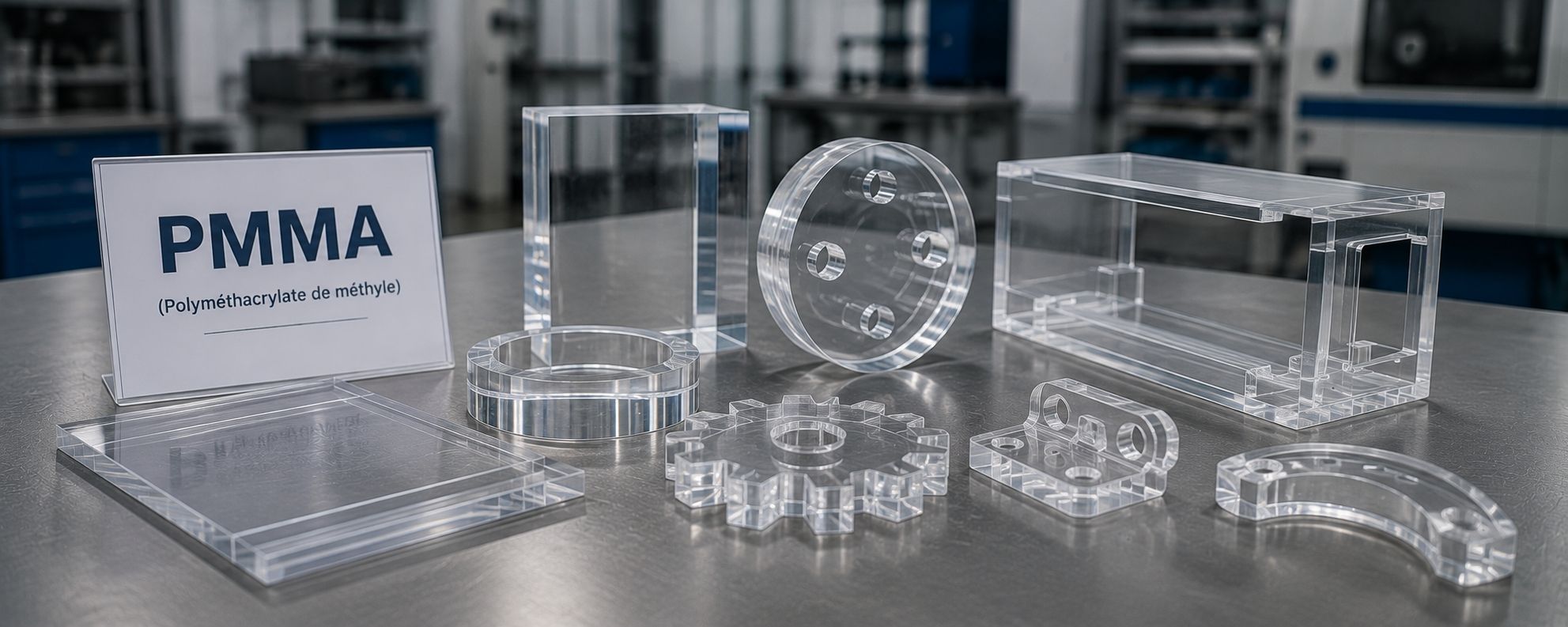
PMMA, often known under its commercial names such as Plexiglas® or Altuglas®, is the reference transparent thermoplastic in industry. Offering optical clarity superior to that of glass while being twice as light, it is the essential material for technical glazing, visual protections and parts requiring perfect light transmission.
Like glass, but better
- Comprehensive support, from design to industrialization
- Detailed identification of your technical needs
- Advice on the choice of the most suitable technologies
What is PMMA plastic?
Poly(methyl methacrylate) or PMMA is an extremely rigid transparent thermoplastic polymer. On the industrial market, it comes in two main manufacturing families that influence its behaviour during processing:
- Cast PMMA (CN): cast between two glass plates, it offers the best possible optical quality, excellent chemical resistance and a perfectly flat surface. It is the preferred choice for laser cutting and machining.
- Extruded PMMA (XT): pushed through a die, it features very consistent thickness tolerances. It is often preferred for thermoforming or bending of large series.
The main properties and advantages of PMMA
PMMA's widespread presence in industry and design comes from a set of unique characteristics:
- Exceptional optical properties: it transmits up to 92% of visible light, which is superior to standard glass. It offers unrivalled surface brilliance and does not distort vision.
- UV and weather resistance: unlike many plastics, PMMA does not yellow or deteriorate under UV rays, making it perfect for outdoor applications.
- Mechanical properties: it is very rigid and has excellent surface hardness, making it far more scratch-resistant than other transparent plastics such as polycarbonate. Furthermore, it is 50% lighter than glass.
- Eco-responsibility: PMMA is a 100% recyclable material that can be remelted to create new sheets without major loss of properties.
The limitations of PMMA: which applications should it be avoided for?
Although exceptional, PMMA is not suited to every situation. Here are its main limitations:
- Sensitivity to extreme impacts: although more resistant than glass, PMMA remains a "brittle" material. Under a violent impact, it can break or crack. If your part needs to withstand violent shocks or vandalism, we will direct you towards polycarbonate.
- Moderate thermal resistance: its continuous service temperature should generally not exceed 80 °C to 90 °C, beyond which it begins to soften.
- Sensitivity to aggressive solvents: PMMA is attacked by strong solvents (such as acetone), concentrated alcohols and certain industrial cleaning products, which can cause microcracks ("crazing") or cloud the material.
How does Plastisart process PMMA?
PMMA requires genuine expertise to preserve its optical purity. At Plastisart, we master all the techniques to bring out the best in it:
- Laser cutting and engraving: this is the king of techniques for cast PMMA. The laser cuts the material by vaporising it, leaving instantly smooth, brilliant and naturally polished edges, with no mechanical rework required.
- Bending and draping: we heat sheets in an oven to create curved panes or domes (by gravity) without ever altering the optical quality or creating distorting reflections.
- CNC machining: for thick blocks or transparent mechanical parts, our machining centres mill and drill PMMA with millimetre precision.
- Invisible bonding (UV and solvent): for assembling covers or display cases, we use solvent or photopolymerisable (UV) adhesives that guarantee an ultra-strong and 100% transparent joint, with no marks or bubbles.
Industry sectors and typical industrial applications
PMMA is omnipresent whenever transparency, aesthetics and weather resistance are required:
- Protective machine guards allowing mechanisms to be seen, incubators, laboratory equipment
- Lightweight glazing, portholes, glider canopies, helicopter bubbles
- High-end display units, protective display cases, thick covers with a "glass" effect
- Illuminated panels, LED diffusers, outdoor signage
Industrial sector
Transparent protective machine guards making mechanisms visible during operation without interrupting production.
Medical & pharmaceutical sector
Incubators, laboratory equipment and transparent protections for care environments with flawless optical quality.
Aerospace & defence sector
Portholes, glider canopies and helicopter bubbles in blown PMMA with perfect light transmission.
Transport & mobility sector
Lightweight glazing and transparent protections for special vehicles, cabs and railway equipment.
Food processing sector
Transparent protections and display cases for packaging lines and food product displays.
Communication & events sector
High-end display units, illuminated totems, protective display cases and UV-resistant outdoor signage.
Cosmetics sector
Thick covers with a "glass" effect, premium presentation display cases and transparent protections for luxury products.
Office sector
Partition panels, workstation protections and transparent design elements for office environments.
Building & construction sector
Roof domes, skylights and architectural glazing elements in UV and weather-resistant PMMA.
Energy & environment sector
Transparent covers and protections for measuring equipment and environmental monitoring stations.
Sports & leisure sector
Boat portholes, cockpit glazing and transparent protections for marine and sports equipment.
Why choose Plastisart for your PMMA parts?
Working with a transparent plastic forgives no errors: the slightest scratch, bubble or thermal stress is immediately visible. At Plastisart, we handle PMMA in a controlled environment. Our design office selects the exact grade (cast or extruded) depending on whether it needs to be thermoformed, machined or bonded. From the raw sheet to the finished, assembled and polished part, we manage everything in-house to guarantee flawless optical quality.
FAQ about PMMA
What is the difference between PMMA (Plexiglas) and polycarbonate (PC)?
This is the great dilemma of transparent plastics. PMMA is unbeatable on optical quality, UV resistance (does not yellow) and scratch resistance. Polycarbonate is virtually unbreakable and withstands extreme impacts, but scratches more easily and tends to yellow outdoors if untreated.
How do you clean a PMMA part or guard?
Never use solvents, acetone, methylated spirits or standard glass cleaners, as they will cause microcracks and whiten the material. PMMA is simply cleaned with warm soapy water, a soft cloth (microfibre) and optionally a specific antistatic cleaner for plastics.
Can scratched or machined PMMA be polished?
Yes, unlike other plastics, PMMA polishes extremely well. If it has been machined, we can re-polish the edges mechanically (diamond polishing) or thermally (flame polishing). In the case of micro-scratches on an existing part, it is possible to restore its brilliance using specific polishing compounds.