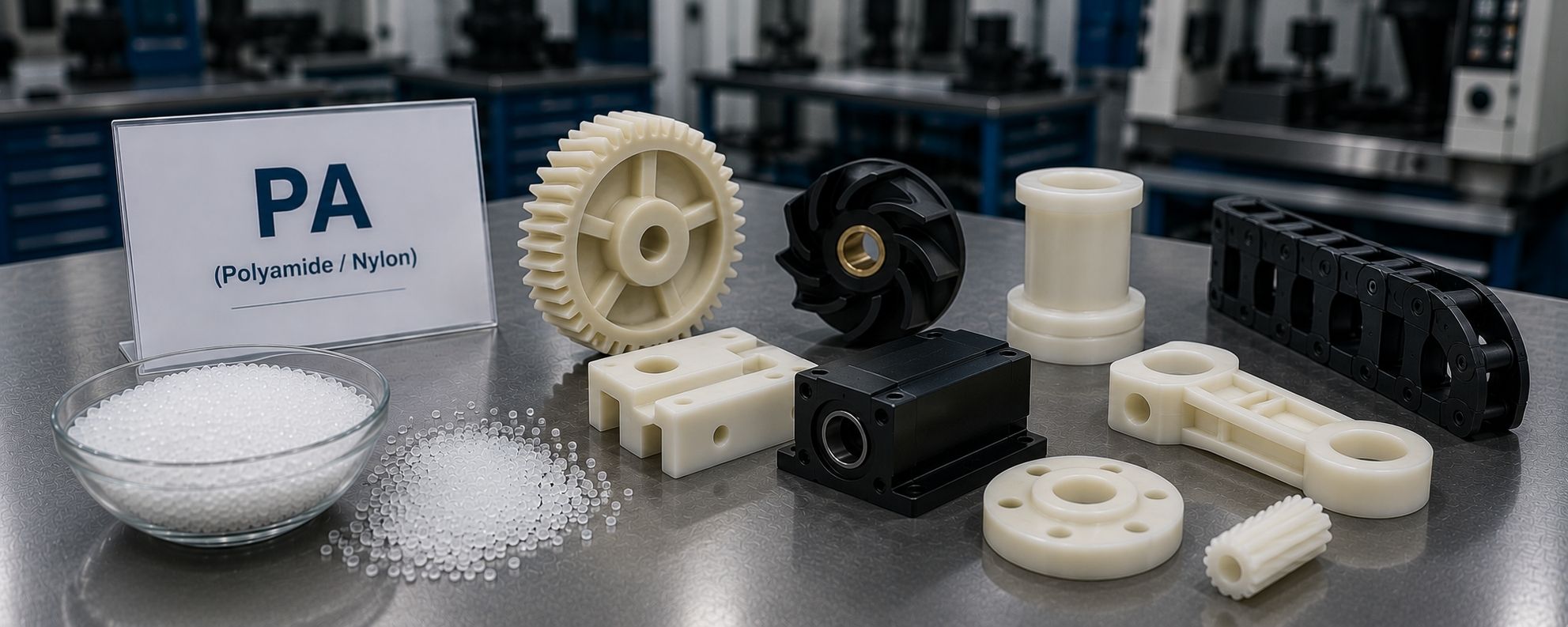
Polyamide (PA), universally known under its historic name "Nylon", is a leading technical thermoplastic. Remarkable for its incredible robustness, its ability to absorb impacts and its abrasion resistance, it is the essential material for mechanical parts subject to heavy physical and thermal stresses.
Built to take the impact
- Comprehensive support, from design to industrialization
- Detailed identification of your technical needs
- Advice on the choice of the most suitable technologies
What is PA (polyamide) plastic?
Polyamide is a semi-crystalline thermoplastic polymer. Originally developed for the textile industry (the famous Nylon), it quickly conquered heavy industry and mechanical engineering. On the technical plastics market, our engineers work primarily with two main families:
- PA 6: the most common grade. It offers excellent resilience (ability to absorb impacts), very good mechanical damping and high wear resistance.
- PA 66: it has a denser molecular structure. It is therefore more rigid, harder and resistant to slightly higher service temperatures than PA 6, but somewhat less resilient to extreme impacts.
The main properties and advantages of polyamide
PA is the material of choice for design offices developing wear parts or structural components intended to replace metals:
- Wear and abrasion resistance: this is its absolute strong point. PA excels in dusty or abrasive environments. It withstands intense and prolonged friction without degrading.
- Very high impact resistance: polyamide has the distinctive property of absorbing impact energy (excellent damping capacity) without cracking, making it ideal for parts subject to vibrations or repeated blows.
- Excellent thermal resistance: technical polyamides retain their properties at high temperatures, often up to 85 °C to 100 °C continuously, with possible peaks to 160 °C for certain formulations.
- Targeted chemical resistance: PA offers excellent resistance to hydrocarbons, lubricating oils, greases and fuels (hence its ubiquity in the automotive sector).
The limitations of PA: which applications should it be avoided for?
Using polyamide requires genuine engineering expertise, as this material has a very particular physical characteristic that must be anticipated:
- Hygroscopicity (moisture absorption): PA naturally absorbs water and moisture from the air (up to 8% of its weight for certain grades). When saturated with water, its volume swells and it becomes more flexible. It is therefore not recommended for parts requiring ultra-precise dimensional tolerances in humid environments. For absolute precision in a humid environment, we will direct you towards POM.
- Sensitivity to acids: unlike HDPE or PTFE, polyamide is attacked by strong acids and highly oxidising solutions.
- Delicate machining without experience: if not "conditioned" (too dry), it can be brittle when machining. If poorly clamped, its flexibility can cause dimensional defects.
How does Plastisart process polyamide?
PA's behaviour (particularly its flexibility and continuous chip) requires a high-performance machine fleet and experienced operators. We process it primarily through:
- CNC machining (milling and turning): this is the king process for polyamide. We machine blocks, sheets or cylindrical blanks (cast PA 6) to produce running rollers, large gears, pulleys and sliding pads. Our very sharp cutting tools avoid overheating and melting of the material.
- Mechanical component assembly: we favour designing sub-assemblies through mechanical assemblies or welding to guarantee maximum resistance.
- Insert integration: thanks to PA's high resilience, we can insert (by swaging or screwing) tapped metal inserts that hold firmly against vibrations.
Industry sectors and typical industrial applications
Polyamide is the preferred replacement solution for parts traditionally machined in bronze or steel:
- Wear pads for cranes and telescopic trucks, lifting sheaves, large transmission gears, running rollers
- Under-bonnet components (oil and heat resistant), bearings, chain guides, technical connectors
- Transfer stars, Archimedean screws, sliding guides certified for food contact
- Damping bushings, high-load trolley wheels, mechanical stops
Industrial sector
Wear pads for cranes, lifting sheaves, large transmission gears and running rollers in PA for heavy industrial machinery.
Medical & pharmaceutical sector
Precision mechanical components in PA for medical equipment requiring impact absorption and vibration resistance.
Aerospace & defence sector
Wear parts and structural components in glass fibre-filled PA for equipment subject to heavy mechanical stresses.
Transport & mobility sector
Under-bonnet components resistant to oils, bearings, chain guides and technical connectors for special vehicles and automotive.
Food processing sector
Transfer stars, Archimedean screws and sliding guides in food-certified PA grades for conveyor lines.
Communication & events sector
Wheels, rollers and damping mechanisms in PA for modular exhibition structures subject to repeated stresses.
Cosmetics sector
Gears and drive mechanisms in PA for packaging equipment subject to intensive wear cycles.
Office sector
Running rollers, drive wheels and damping bushings in PA for office equipment and industrial printing systems.
Building & construction sector
High-load trolley wheels, sliding pads and mechanical stops in PA for handling equipment on construction sites.
Energy & environment sector
Wear parts for pumps, valves and industrial equipment exposed to hydrocarbons and lubricating oils.
Sports & leisure sector
Running rollers, pulleys and damping parts in PA for sports and leisure equipment subject to repeated impacts.
Why choose Plastisart for your PA parts?
Machining a Nylon component requires anticipating its final environment. At Plastisart, our design office calculates the impact of moisture absorption on your dimensional tolerances before even starting production. Furthermore, we work with a multitude of modified grades: glass fibre-filled PA (for extreme rigidity), molybdenum disulphide or oil-filled PA (for enhanced self-lubricating effect). We thus guarantee you the exact material for your wear requirement.
FAQ about polyamide (PA / Nylon)
What is the difference between PA (Nylon) and POM (Acetal)?
This is the classic duel in plastic mechanics. Choose PA (Polyamide) if your part will undergo violent impacts, heavy vibrations or severe abrasive wear (dust, sand). Choose POM (Acetal) if your part operates in water or humidity and requires extremely tight and stable dimensional tolerances.
What does a "glass fibre-filled" polyamide (PA-GF) mean?
To compensate for PA's natural flexibility and limit its moisture absorption, manufacturers integrate glass fibres (often at 30%, noted PA6 GF30). This material then becomes extremely rigid and hard, with enhanced dimensional stability and tenfold thermal resistance. It is one of the most "metal-like" plastics in its behaviour.
Is polyamide compatible with negative temperatures (extreme cold)?
Yes, but under certain conditions. In its dry state, standard PA can become brittle below 0 °C. However, if it has absorbed its natural moisture content (conditioned state), it retains excellent resilience and impact resistance down to temperatures of -30 °C to -40 °C. Specific PA grades formulated to resist impacts at very low temperatures also exist.