Plastic blow moulding encompasses two distinct techniques that share the same fundamental principle: shaping a thermoplastic by air injection. Nevertheless, they apply to very different part families. At Plastisart, we have mastered both processes for many years and can therefore respond to a wide variety of requests.
Extrusion blow moulding is the reference process for manufacturing industrial hollow bodies: tanks, canisters, ducts, bellows, technical containers. Contact-free blow moulding is a more specialised technique, particularly used for manufacturing parts with high optical quality such as domes, bubbles and canopies, where the absence of contact with tooling is the prerequisite for preserving the transparency and surface homogeneity of the part.
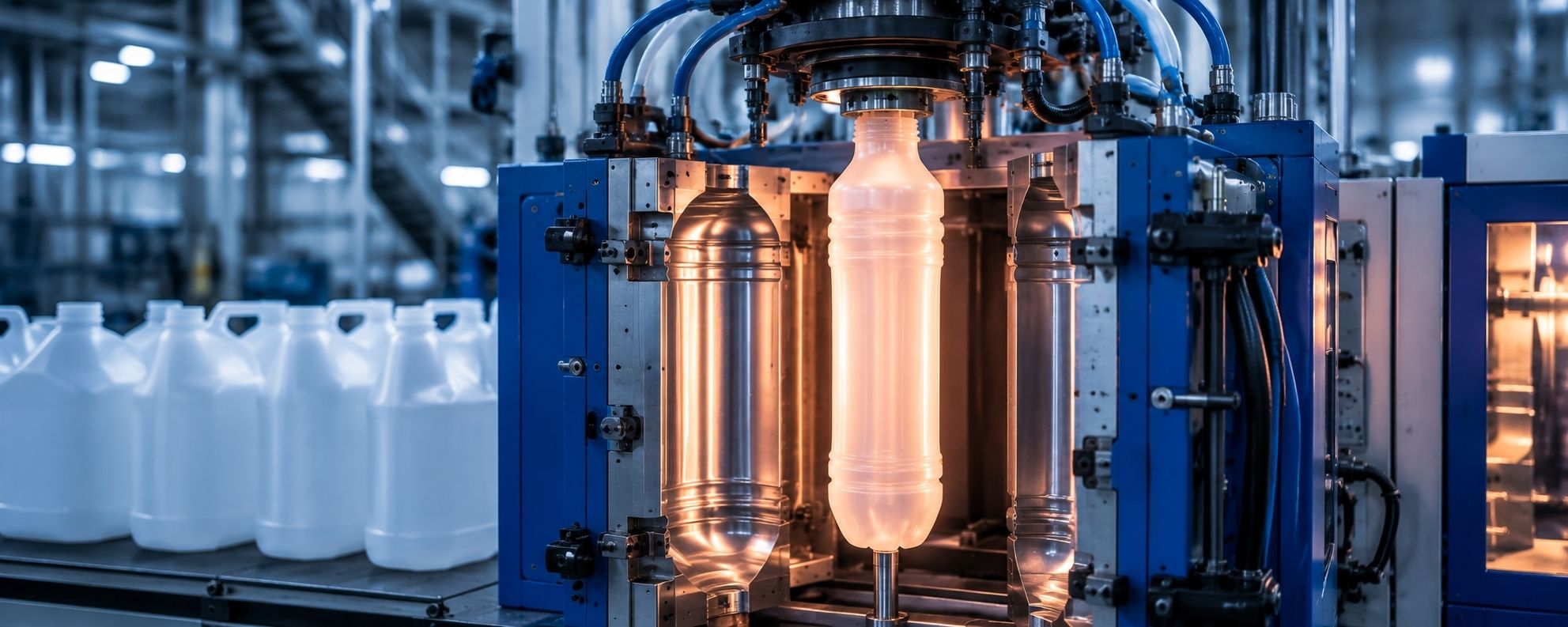
Extrusion blow moulding for manufacturing hollow bodies in thermoplastics
The principle of extrusion blow moulding consists of continuously extruding a tube of molten thermoplastic material, called a parison, then closing a two-half-shell mould around this parison. Air is then injected under pressure inside the tube, which inflates and presses against the mould walls. Once the part has cooled, the mould opens and the hollow part is demoulded. Excess material is eliminated by deflashing.
This process allows hollow bodies to be produced whose internal shape cannot be demoulded by other techniques. It is particularly used to manufacture a tank with an opening smaller than its body, a bent duct, a bellows with convolutions, a vat with integrated handles. It is a solution that achieves at a reasonable cost what plastic injection, thermoforming or plastic fabrication cannot.
At Plastisart, extrusion blow moulding is generally carried out on industrial technical parts, in materials adapted to the constraints of each application.
The advantages of extrusion blow moulding
- Tooling cost lower than plastic injection for parts of the same volume
- Significant design freedom: complex shapes, integrated handles, threaded neck, fastening elements directly moulded into the part
- One-piece part: without welds or assembly for better tightness
- Use of materials such as HDPE and PP for excellent chemical resistance
Available materials for extrusion blow moulding
We work with many materials such as HDPE, PP, LDPE and their variants according to the chemical, food-grade or mechanical requirements of the application.
Sectors and applications for extrusion blow moulding
- Tanks and technical containers for the chemical and food processing industry
- Ducts and tubing for process equipment
- Bellows and flexible parts for mechanical applications
- Hollow bodies for medical and pharmaceutical equipment
Contact-free blow moulding for optical parts without distortion
Contact-free blow moulding is a specialised thermoforming technique in which a thermoplastic sheet is heated then freely blown into a bubble by air injection, without any physical tooling coming into contact with the surface of the part during the forming phase. The final shape is defined by the quantity of air injected and the geometry of the holding frame.
The absence of contact is the key to this technique: it guarantees a perfectly smooth surface, without marks, without mould traces and without optical distortion. This is an essential factor for producing domes, bubbles, canopies and transparent protections with irreproachable optical quality.
At Plastisart, contact-free blow moulding is one of our historical areas of expertise. We produce parts with exceptional optical clarity in PMMA and polycarbonate, used in demanding applications:
- Aeronautical canopies
- Protective domes for measuring instruments
- Observation domes
- Protective bubbles for meteorological equipment
- Transparent protections for industrial and medical equipment
Available materials for contact-free blow moulding
We work with many thermoplastic materials such as PMMA and polycarbonate and select the grades adapted to the optical clarity, UV resistance and mechanical strength requirements of each part.
Sectors and applications for contact-free blow moulding
- Canopies and domes for the aerospace and defence sector
- Protective domes for meteorological and observation instruments
- Transparent protective bubbles for surveillance and measuring equipment
- Curved glazing for industrial and medical equipment
How a project unfolds at Plastisart
Whatever the process, here is how our projects generally unfold:
- Analysis of the specifications by our design office: part geometry, materials to be used, required volumes, usage constraints, finishing requirements
- Design and in-house manufacture of tooling for extrusion blow moulding and definition of forming parameters for contact-free blow moulding
- Production of parts via the previously chosen manufacturing process
- Quality and dimensional inspection of parts before delivery
Two processes but a shared mastery of blow moulding at Plastisart
Extrusion blow moulding and contact-free blow moulding respond to clearly distinct industrial needs, but allow parts to be obtained that are impossible to produce with other processes. At Plastisart, both techniques are part of our complete plastics service offering. We are therefore able to support industrials who need technical hollow bodies or high-quality optical parts.
FAQ
What is the difference between extrusion blow moulding and contact-free blow moulding?
Although both techniques use air injection under pressure, their objectives are opposite. Extrusion blow moulding encloses a tube of molten plastic in a mould to create industrial hollow bodies (tanks, ducts, bellows). Contact-free blow moulding freely inflates a heated plastic sheet like a bubble, without any physical mould, to obtain transparent optical parts (domes, canopies) without the slightest contact mark.
Why is extrusion blow moulding more economical than plastic injection for hollow bodies?
To manufacture a hollow part in plastic injection, a complex mould with very costly retractable cores is required, or two half-shells must be injected and then welded. Extrusion blow moulding allows a one-piece part to be designed in a single operation. The two-half-shell mould also undergoes much less pressure, which considerably reduces tooling costs compared to injection.
How is the tightness of blow-moulded tanks and ducts guaranteed?
This is the great advantage of extrusion blow moulding: the final part is one-piece. Since the plastic inflates as a single unit inside the mould, the part contains no weld bead, no bonding plane and no mechanical assembly. This structurally eliminates any risk of leakage or weak point, which is ideal for storing fluids or chemical products.
How does contact-free blow moulding achieve perfect optical quality?
In a classic thermoforming process, hot plastic is pressed against a mould, which can create micro-scratches, grain or visual distortions. In contact-free blow moulding, the plastic sheet (PMMA or polycarbonate) is inflated in open air by simple air injection. The surface touches no tooling while it takes its shape. The result is perfect crystalline clarity, essential for aeronautical canopies, observation domes or camera bubbles.
What are the geometry limitations for a part made by extrusion blow moulding?
This process is ideal for complex shapes that cannot otherwise be demoulded (bent ducts, neck threading, integrated handles). However, wall thickness can vary slightly between zones close to the mould and zones of strong stretching. Our design office analyses your specifications from the outset to optimise the parison geometry and guarantee the minimum thicknesses required by your application.