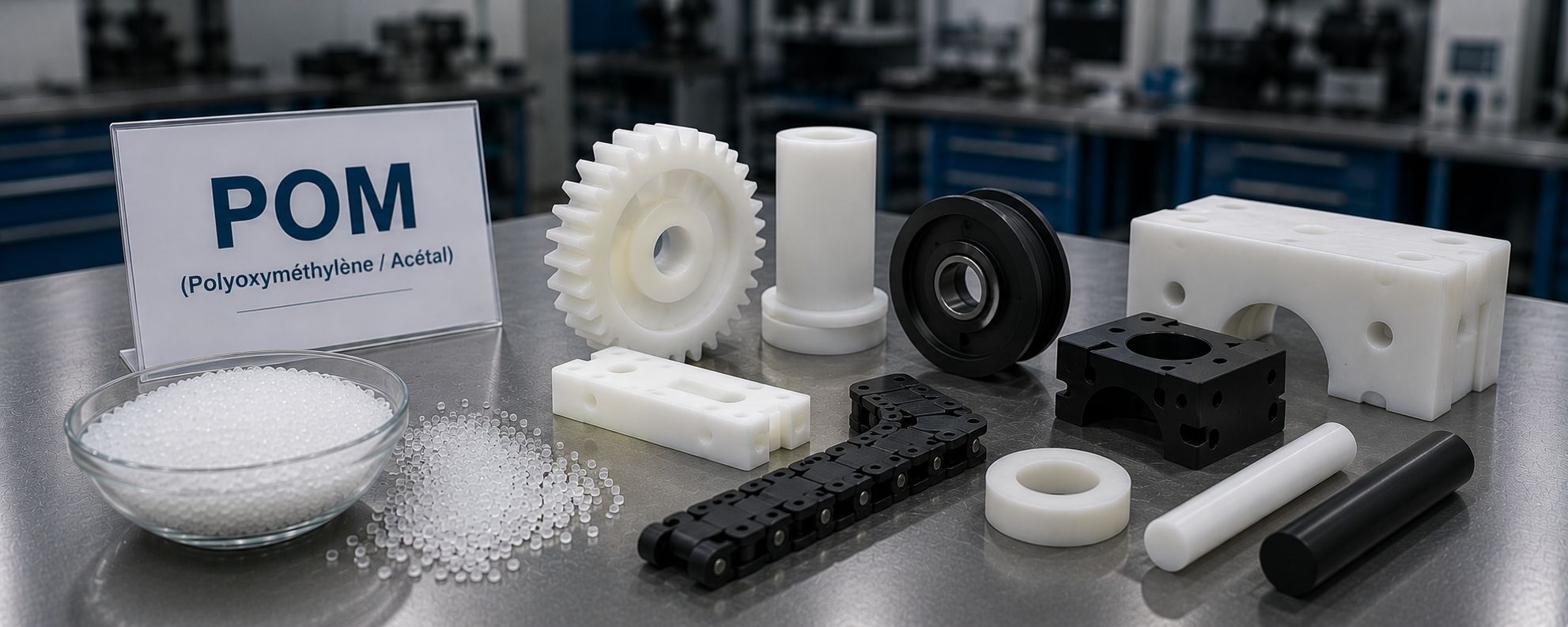
POM, commonly called Acetal or known under its historic brand name Delrin®, is the absolute reference for high-precision mechanical parts. Endowed with exceptional rigidity and a very low friction coefficient, it is the preferred material for engineers replacing moving metal parts (gears, bearings, slides).
Precision without friction
- Comprehensive support, from design to industrialization
- Detailed identification of your technical needs
- Advice on the choice of the most suitable technologies
What is POM (polyoxymethylene) plastic?
Polyoxymethylene (POM) is a semi-crystalline technical thermoplastic polymer. Very dense and rigid, it is designed for demanding mechanical applications. On the industrial market, our design offices distinguish two main variants according to your requirements:
- POM-C (Copolymer): this is the most common grade. It offers better chemical resistance (particularly to solvents and strong bases), excellent hydrolysis resistance (hot water) and better resistance to thermal degradation.
- POM-H (Homopolymer / e.g. Delrin®): it has a more rigid molecular structure, giving it slightly superior mechanical characteristics (hardness, tensile strength) compared to POM-C, but with lower chemical resistance.
The main properties and advantages of POM
POM is the natural choice when precision and wear resistance are the absolute priorities of the specifications:
- Perfect dimensional stability: unlike other technical plastics, POM absorbs virtually no moisture (very low hygroscopicity). A machined POM part retains its exact dimensions, even in a humid environment or when submerged.
- Low friction coefficient: it has excellent dry sliding properties and very high wear resistance, making it ideal for friction parts without lubrication.
- High mechanical performance: it offers great rigidity, excellent fatigue resistance (for snap-fit or clip parts) and good resilience (elastic recovery).
- Exceptional machinability: it is the easiest plastic to machine. It generates short chips and does not melt on the tool, allowing machining tolerances comparable to metals to be achieved.
The limitations of POM: which applications should it be avoided for?
To guarantee the success of your project, it is essential to know the environments in which POM is not recommended:
- Sensitivity to strong acids: POM does not resist highly concentrated acids (pH < 4) or strongly oxidising agents well. For tanks or parts submerged in strong acids, we will favour HDPE or PTFE.
- UV sensitivity: in its natural state (white/natural), POM yellows and loses mechanical resistance if exposed to sunlight for extended periods. For outdoor use, a black POM grade (loaded with carbon black) or UV-treated grade is essential.
- Bonding very difficult: like HDPE, POM has very low surface energy. Industrial adhesives do not bond to it without heavy prior surface treatments (plasma, flame treatment).
How does Plastisart process POM?
Due to its very sharp melting point, POM is not suited to thermoforming. At Plastisart, we process it to extract the best mechanical performance from it:
- CNC machining (milling and turning): this is our flagship process for POM. Using our 3 and 5-axis centres, we machine gears, bushings, cams and shafts with millimetre precision. Its cutting behaviour allows exceptionally smooth surface finishes to be achieved.
- Mechanical assembly: since bonding is complex, we design your POM sub-assemblies favouring intelligent mechanical assemblies: screwing, metal insert swaging, or snap-fit systems (clips) that exploit its high fatigue resistance.
- Laser marking: POM reacts very well to laser engraving for permanently applying serial numbers, assembly marks or logos, without creating burrs.
Industry sectors and typical industrial applications
Whenever a part needs to slide, rotate or snap repeatedly without wearing out, POM is the solution:
- Gears, bearings, cams, sprockets, friction bushings, running rollers
- Distribution stars, conveyor guides, scrapers FDA-certified for direct food contact
- Surgical instrument handles, dosing components, test implants
- Connectors, closure systems, wiper components, push buttons
Industrial sector
Gears, bearings, cams, friction bushings and running rollers in POM for precision industrial machinery.
Medical & pharmaceutical sector
Surgical instrument handles, dosing components and precision parts resistant to repeated sterilisation cycles.
Aerospace & defence sector
Precision mechanical parts in POM for embedded equipment requiring dimensional stability and low friction.
Transport & mobility sector
Connectors, closure systems, wiper components and push buttons for special vehicles and automotive.
Food processing sector
Distribution stars, conveyor guides and scrapers in POM-C certified FDA and EU 10/2011 for direct food contact.
Communication & events sector
Closure mechanisms and sliding parts for display systems and modular exhibition structures.
Cosmetics sector
Dosing mechanisms and precision parts for dispensers and cosmetic packaging equipment.
Office sector
Gears, cams and snap-fit systems for office equipment and industrial printers.
Building & construction sector
Sliding parts and closure mechanisms for joinery and technical building equipment.
Energy & environment sector
Pump components, valves and precision parts for water treatment and distribution equipment.
Sports & leisure sector
Adjustment mechanisms, closure systems and self-lubricating parts for precision sports equipment.
Why choose Plastisart for your POM parts?
Machining plastic with metal precision requires specific skills. At Plastisart, our CNC operators adapt spindle speeds and tool geometries specifically for POM, avoiding any internal stress in the material. Our design office guides you in choosing the right grade (POM-C for food contact or hot water, POM-H for extreme rigidity) and designs your mechanical sub-assemblies without using unsuitable adhesives.
FAQ about POM (Acetal)
What is the difference between POM and PA (Nylon) for a mechanical part?
Nylon (PA) is more resistant to violent impacts and severe abrasion, but it is a hygroscopic plastic (it absorbs water), which alters its dimensions and rigidity. POM does not absorb moisture. If your part requires very strict dimensional tolerances or operates in a humid environment, POM is significantly superior.
Can POM be used for parts in contact with food?
Yes, POM-C (Copolymer) is one of the most widely used plastics in the food processing industry. In its natural state (white) or specifically coloured (often blue for optical detection), it is odourless, tasteless and complies with strict regulations (FDA, EU 10/2011) for direct contact with foodstuffs, including during frequent hot water washes.
Why is POM said to be "self-lubricating"?
POM's molecular structure gives it an extremely low natural friction coefficient. This means that a gear or a slide in POM can operate smoothly against another plastic or a metal without requiring the addition of oil or grease. This considerably reduces maintenance costs and avoids contamination in clean environments (medical, food processing).