Hot bending and hot forming are two thermoplastic transformation techniques that allow sharp angles, right-angle structures and complex angular shapes to be created from standard sheets, without investment in moulding tooling. Complementary to bending and draping for curves, these processes are the natural answer whenever a plastic part must present defined angles, assembled flat faces or a polygonal geometry.
At Plastisart, hot bending and hot forming have been part of our transformation service offering since our foundation. They allow us to respond quickly to projects involving housings, angular covers, ducts, tanks and protective structures that combine several flat faces with precise angles.

The principle of hot bending
Hot bending consists of heating a thermoplastic sheet locally along a defined fold line, using a wire resistance, a heating bar or a quartz bending machine. When the material reaches its softening temperature along this line, it becomes malleable and can be bent to the desired angle without cracking or weakening. The part is held in position until completely cooled, then the angle is permanently set.
The precision of the angle obtained depends on several factors: the quality of the linear heating, temperature control according to the material and thickness, bending speed and cooling conditions. At Plastisart, our bending machines allow us to work large-format sheets and obtain precise angles over significant bending lengths.
One of the key advantages of hot bending over bonding or mechanical assembly is the continuity of the material: the bent part is in one piece, with no joint or weld bead at the angle. This continuity improves the mechanical strength of the part and its durability over time, particularly for parts subject to repeated stresses or aggressive environments.
Hot forming: for more complex geometries
Hot forming is an extension of hot bending that applies to parts requiring multiple angles, U or C shapes, closed housings or multi-face structures. The sheet is heated successively on each fold line, following a defined sequence to avoid parasitic deformations and guarantee the final geometry.
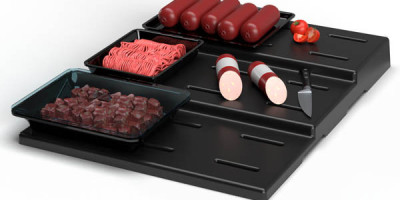
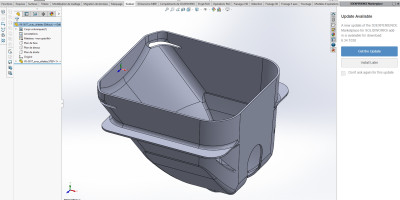
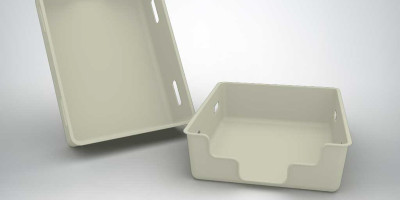
Hot forming allows open housings, U or L profiles, multi-face covers, rectangular ducts and angular protective structures to be produced without resorting to a thermoforming mould or multi-component bonded assembly. The part comes from a single starting sheet, which simplifies manufacturing, reduces the number of operations and improves the dimensional consistency of the final result.
Materials compatible with hot bending and forming
The thermoplastics most commonly shaped by hot bending and forming are:
- PMMA
- Polycarbonate (PC)
- Rigid PVC
- ABS
- PETG
- PS
Each material has a specific bending temperature range that must be respected precisely: too low and the material cracks or whitens along the fold line; too high and it degrades or loses its mechanical and optical properties.
For transparent materials such as PMMA or polycarbonate, temperature control is particularly critical to avoid zones of opacification or internal stress that impair optical clarity. Our experience with these materials allows us to guarantee clean folds, without marks or visual degradation.
The different industrial applications
Hot plastic bending and forming at Plastisart cover a wide range of applications: protective housings for electronic components and measuring equipment, angular covers and cladding for industrial machines and robots, custom ventilation ducts and conduits, tanks and retention structures in HDPE or PP, facades and control panels for technical equipment, protections and casings for various sectors.
These techniques are particularly suited to projects where the part must be produced quickly, in small series, from a drawing, without delays or costs related to tooling manufacture.
Why choose Plastisart?
Hot bending and forming are direct, fast and economical techniques for producing custom angular plastic parts. At Plastisart, these techniques integrate into a complete transformation offering that covers the full spectrum of plastic processes. Whether your project requires angles, curves or a combination of both, we have the equipment and experience to deliver it.
FAQ
Hot bending and bending: two complementary techniques?
The distinction is simple: hot bending creates defined angles and sharp edges, while bending creates curves and progressive radii. Both techniques start from the same principle of localised heating, but apply to different geometries. For a part that combines angles and curves, both techniques can be combined on the same part at Plastisart. This technical versatility is one of the advantages of working with a transformer mastering all forming processes.
What is the advantage of a bent part over a bonded or screwed structure?
The continuity of the material. A hot-bent part comes from a single plastic sheet. The absence of joints, weld beads or mechanical fasteners at the angles eliminates weak zones. This guarantees maximum mechanical strength, natural tightness and better durability over time.
Is a mould investment necessary to bend or form plastic?
No, and that is the great strength of this process. Hot bending and forming are carried out directly on standard sheets using wire resistances and simple bending jigs. With no fixed mould costs to amortise, this technique is ultra cost-effective from the very first part and ideal for small series.
How do you prevent transparent plastic from whitening during bending?
If plastic is bent at too low a temperature, it undergoes internal stresses that cause microcracks or whitening of the fold line. Conversely, too high a temperature creates bubbles. Our regulated equipment allows us to heat the material to the nearest degree to guarantee clean, transparent folds without any optical alteration.