Prototyping is the step that separates an idea from a finished, ready-to-use product. For an industrial manufacturer, it determines everything that follows: a poorly conceived prototype leads to delays, redesign costs and longer production lead times. Conversely, a well-executed and quickly validated prototype allows manufacturing to launch as soon as possible.
As an expert in 3D prototyping of plastic parts, Plastisart does not simply deliver a printed part. Our strength lies in supporting our clients throughout their thinking process, from the first prototype through to production in small, medium or large runs. Everything takes place in-house in our workshops, with our team and the materials we master.
The result: once your prototype is validated, the transition to production happens seamlessly with the same partner, without any break or loss of information.
Design and prototyping
- Comprehensive support, from design to industrialization
- Detailed identification of your technical needs
- Advice on the choice of the most suitable technologies
The different prototyping technologies available at Plastisart
3D Printing
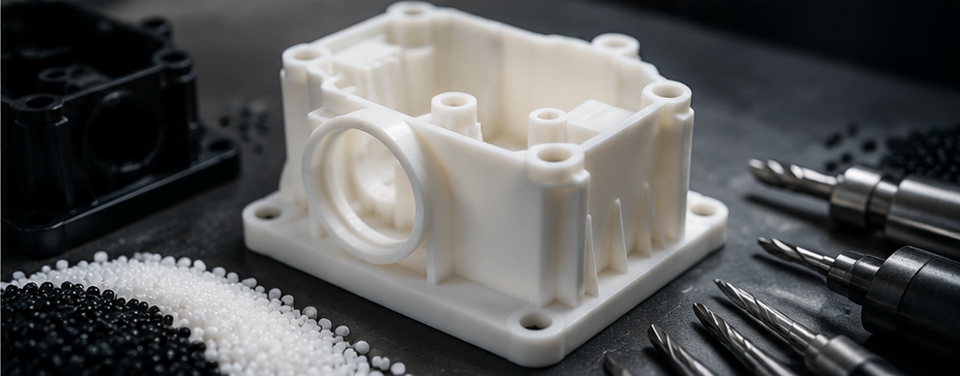
3D printing builds the part layer by layer from a CAD file. It is the fastest solution for obtaining a first physical prototype, testing a geometry or validating an assembly. Several 3D printing technologies coexist, each suited to different applications.
FDM (Fused Deposition Modelling)
A technique based on depositing melted filament layer by layer. Economical, fast, suited to conceptual prototypes and first dimensional checks. Available materials: PLA, ABS, PETG, ASA, PA (nylon), TPU, carbon-filled filaments.
SLA (Stereolithography)
Involves the photopolymerisation of a liquid resin by UV laser. Very smooth surface finish, high resolution. Ideal for visual prototypes, presentation parts or components with fine details.
SLS (Selective Laser Sintering)
Sintering of a polymer powder by laser. Robust parts, complex geometries without support structures, good mechanical resistance. Suited to functional prototypes and small runs of technical parts.
Prototyping by CNC machining
For functional prototypes that need to be tested under conditions close to final production, machining is often more relevant than 3D printing. The machined part presents the same properties as the future series part.
The different types of plastic prototypes
Conceptual prototype
Simplified, low-detail form, intended to validate an idea or ergonomics. Produced quickly and at low cost to facilitate exchanges during the design phase.
Visual prototype
Faithful representation of the final appearance of the part: shapes, finishes, colours. Used for client presentations, marketing validations or product launch files.
Functional prototype
Part machined or printed in a material with properties close to final production. This allows testing of mechanical resistance, adjustments, assemblies and performance under stress.
Pre-production prototype
Part produced using the definitive manufacturing process (thermoforming, RIM injection, etc.) before the series launch. Validates both the design and the process.
Your project in 5 steps
Needs analysis and technical advice
Once we have discussed your requirements, our design office analyses your project: geometry, materials, final use and constraints. Based on this, we recommend the most appropriate technique.
Modelling or retrieval of your files
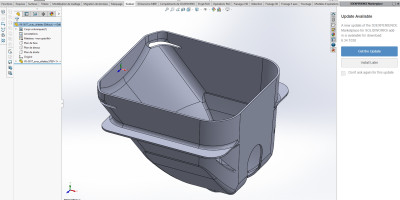
If you already have CAD files, we are able to take them over or adapt them if necessary. If your project starts from a concept or a part to be reproduced, our design office handles the 3D modelling directly.
Prototype manufacturing
Production of the prototype using the appropriate technique. Lead times are generally short: a few days for a 3D printed prototype, one to two weeks for a more complex prototype with machining.
Validation and adjustments if necessary
Testing under conditions of use. Based on these tests, we make the necessary adjustments: dimensions, shape, thickness, fit, etc. We modify the file directly and quickly relaunch the prototype.
Transition to production
Once the prototype is validated, we launch production directly in our workshops, using the most appropriate manufacturing process and material. You therefore have a single point of contact from the beginning to the end of the project.
Why choose Plastisart for your plastic prototyping?
A prototype designed to be manufactured
Our design office designs prototypes taking manufacturing constraints into account from the outset. We avoid unpleasant surprises during production launch.
Fast transition from prototype to production
This is Plastisart's key strength. We manufacture not only prototypes but also production runs. You therefore have a single partner throughout the project.
Controlled lead times
Thanks to our various in-house areas of expertise, we are able to considerably reduce our lead times compared to competitors.
A wide choice of plastic materials
We advise our clients on material selection from the wide range we offer, based on your constraints.
A single point of contact throughout the process
No need for multiple subcontractors for the different phases. No additional delays and no loss of information.
Prototyping is not an end in itself. It is a step in a process that must lead to a finished, compliant, operationally ready part. At Plastisart, we do not separate these two phases. Our ability to cover the complete cycle, from the first 3D mock-up to series production, is what distinguishes our offering from a standard 3D printing service.
Our different business areas
Industrial Sector
Machine guards, equipment protections and structural parts for demanding industrial environments.
Medical & Health Sector
Covers, protections and transparent parts for medical equipment in cleanrooms or operating theatres.
Aerospace & Defense Sector
Canopies, optical curves and lightweight parts for aeronautical and defence applications.
Automotive & Transport Sector
Windscreens for special vehicles, cabin glazing and visual protections for transport equipment.
Agri-food Sector
Parts in food-grade materials (PETG, PMMA) adapted to hygiene and cleaning requirements.
Communication & Events Sector
Displays, domes and curved visual elements for stands, exhibitions and event signage.
Cosmetics Sector
Curved aesthetic parts for premium packaging and presentation displays.
Office & Business Sector
Protections, dividers and ergonomic curved parts for office furniture and equipment.
Building & Construction Sector
Architectural curves, glazing and decorative plastic elements for the construction sector.
Energy & Environment Sector
Curved covers and protections for energy installations and environmental equipment.
Sports & Leisure Sector
Transparent or tinted parts for sports equipment, leisure vehicles and visual protections.
FAQ
What is plastic 3D prototyping?
Plastic 3D prototyping involves producing one or more plastic parts from a digital file, within short lead times, to validate a design before committing to series production. Unlike traditional manufacturing methods that require specific tooling, rapid prototyping requires no initial tooling investment. It allows the shape, dimensions, assembly and functional properties of a component to be tested within a few days, at a controlled cost. 3D printing is the most widespread rapid prototyping technique today, but machining may be more relevant for functional prototypes that need to be tested under conditions close to production reality.
What materials are available for prototyping?
For 3D printing prototyping, we work with a range of technical polymers: PLA, ABS, PETG, ASA (UV resistant), PA (nylon), TPU (flexible), carbon-filled filaments for applications requiring rigidity and lightness. For prototyping by machining, we machine directly in the technical thermoplastic materials from the Plastisart range: PMMA, ABS, POM, PA, PEEK, PTFE, HDPE, PVC, PC. This allows a prototype to be produced with properties exactly identical to those of the series part.
What is the difference between a 3D printed prototype and a series part?
The 3D prototype is used to validate geometry, ergonomics and assembly. However, its mechanical properties and surface finish differ from the final part. The series, produced by thermoforming or RIM injection, will use the definitive polymer (ABS, PEEK, PC) to guarantee the real performance of the specifications.
Can you create the 3D model if we only have a 2D drawing or sketch?
Yes, absolutely. Our integrated design office handles the complete CAD modelling of your part. From paper drawings, 2D files or a simple functional specification, we generate the native 3D files optimised for manufacturing.
What are your lead times for manufacturing and delivering a plastic prototype?
Thanks to our in-house 3D printing and rapid prototyping equipment, we are able to manufacture and ship a prototype within just a few days of 3D file validation. This responsiveness allows you to quickly validate your design milestones.
Do you use prototyping to design future series moulds?
Yes. The prototype allows the part design to be locked in an extremely secure manner. Once you have validated the physical prototype, our mechanical workshop uses this validated 3D model to design and machine the series mould (in resin or aluminium) suited to thermoforming or RIM injection.