Not all plastic parts are necessarily flat or angular. Examples include curved cabin glazing, special vehicle windscreens, curved machine casings or certain industrial equipment protections. These components require curved, concave or convex shapes that are not possible with other techniques.
At Plastisart, these processes are part of the transformation techniques we have mastered for many years. They allow custom curved parts to be produced from standard thermoplastic sheets, with or without moulding tooling depending on the complexity.
Plastic bending: precise curves from sheets
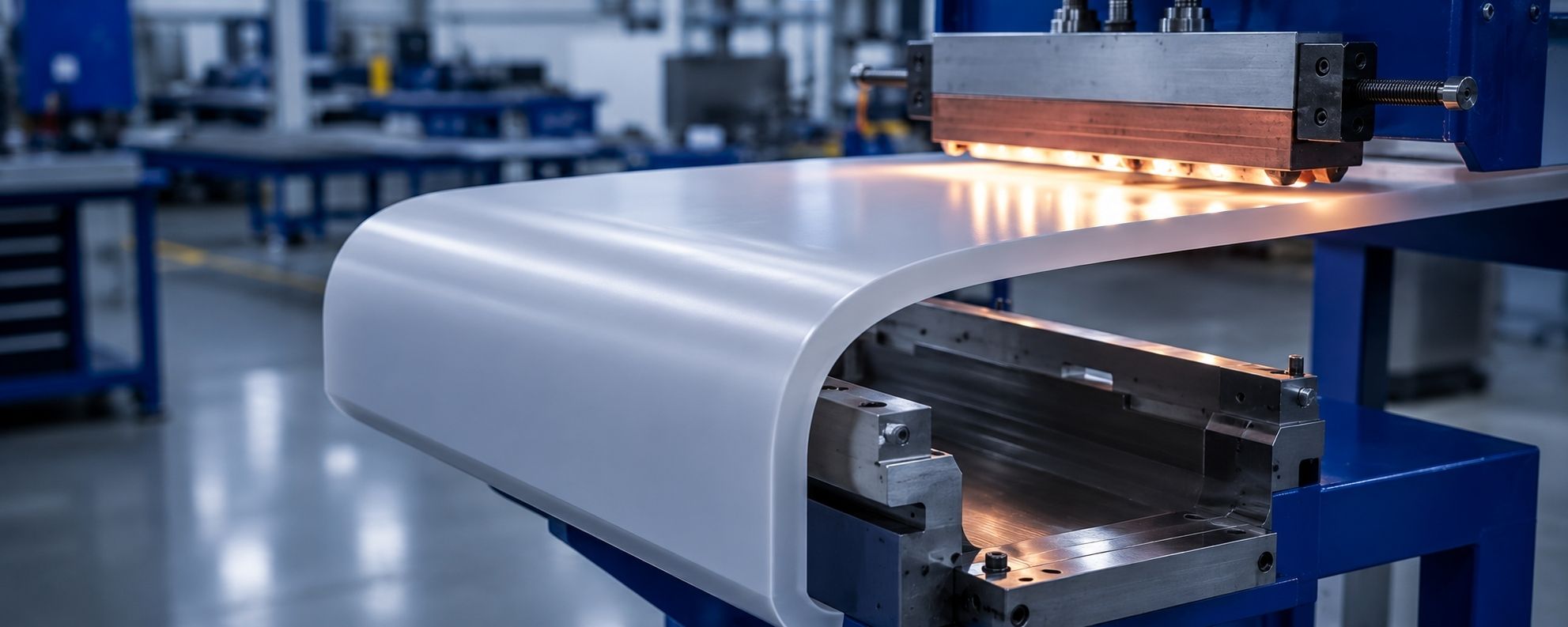
Plastic bending consists of heating a thermoplastic sheet uniformly or locally to its softening temperature, then imposing a precise curvature by applying it to a jig or constraining it mechanically until completely cooled. The part permanently retains the shape obtained once the material has returned to its solid state.
Localised bending
This technique allows a precise curve to be created on a defined part of the sheet, without affecting the rest of the part. It is used for large-diameter radii, arc shapes or gentle curves on transparent sheets such as PMMA or polycarbonate.
Global bending
This process consists of heating the entire sheet, or a large zone, then forming it on a jig to give it a definitive curvature. We use it for parts requiring tighter radii or curvatures over a larger surface area.
Good to know: Plastic bending preserves the mechanical and optical properties of the transformed material, provided that the heating temperature is adapted to the material used. For transparent materials such as PMMA or PC, this temperature control is critical. If poorly managed, it can create internal stresses, surface deformations or a degradation of optical properties.
Plastic draping
Draping is a free-forming technique. The thermoplastic sheet is brought to temperature in an oven until it is sufficiently pliable. It is then positioned on or under a jig and left to cool, conforming to its shape by simple gravity or with light manual assistance. No mechanical pressure or vacuum suction is applied.
This constraint-free technique is ideal for transparent materials because the absence of pressure preserves the optical quality of the part. The risks of distortions and contact marks are lower, making it an ideal technique for glazing parts, domes, architectural curves or visual protections for which optical clarity is essential.
For moderately complex shapes, without deep draw or fine details, it is the technique we favour. For more complex geometries or with stricter dimensional precision, thermoforming is generally more suitable.
Materials suitable for plastic bending and draping
The materials most commonly shaped by bending and draping at Plastisart are:
- PMMA (plexiglass)
- Polycarbonate (PC)
- PETG
- Rigid PVC
- ABS
Each material has its own heating temperatures, hot behaviour and cooling characteristics. Thanks to our sector experience, we master these variables to produce custom parts without internal stresses or residual deformations.
Our different application sectors
Industrial Sector
Machine guards, equipment protections and structural parts for demanding industrial environments.
Medical & Health Sector
Covers, protections and transparent parts for medical equipment in cleanrooms or operating theatres.
Aerospace & Defense Sector
Canopies, optical curves and lightweight parts for aeronautical and defence applications.
Automotive & Transport Sector
Windscreens for special vehicles, cabin glazing and visual protections for transport equipment.
Agri-food Sector
Parts in food-grade materials (PETG, PMMA) adapted to hygiene and cleaning requirements.
Communication & Events Sector
Displays, domes and curved visual elements for stands, exhibitions and event signage.
Cosmetics Sector
Curved aesthetic parts for premium packaging and presentation displays.
Office & Business Sector
Protections, dividers and ergonomic curved parts for office furniture and equipment.
Building & Construction Sector
Architectural curves, glazing and decorative plastic elements for the construction sector.
Energy & Environment Sector
Curved covers and protections for energy installations and environmental equipment.
Sports & Leisure Sector
Transparent or tinted parts for sports equipment, leisure vehicles and visual protections.
Custom curves, without heavy tooling investment
Bending and draping allow curved and shaped parts to be produced within your lead times and without significant tooling investment. At Plastisart, these techniques are part of our broad plastics service offering. We master all plastic processes, which allows us to direct each project towards the most suitable technique and combine several approaches when the complexity of the part justifies it.
FAQ
Bending or draping: when to use them?
These two techniques respond to very specific situations in a plastic manufacturing project. They are particularly relevant in the following cases: when the part is intended to be transparent and optical quality must be preserved; when volumes are low or the part is a one-off and a thermoforming tooling investment is not justified; when the geometry is curved but without deep draw or complex geometric detail; and when materials such as PMMA or PC are used for their resistance or transparency.
These techniques do not replace thermoforming for large series or complex geometries, but they constitute a fast and economical route to quality curved parts.
What is plastic draping and what is its main advantage?
Draping consists of heating a sheet in an oven, then depositing it on a jig so that it conforms to the shape by simple gravity, without mechanical pressure or suction. Since the material is not constrained, this technique ideally preserves the crystalline clarity of transparent plastics (PMMA, polycarbonate) and eliminates the risks of contact marks.
How do you guarantee that glazing does not lose its clarity after heating?
This is the whole challenge of our expertise. Optical materials such as PMMA or polycarbonate (PC) are very sensitive: a poorly controlled temperature creates internal stresses that blur the material or distort vision. Thanks to our regulated heating equipment and experience, we form sheets to the nearest degree to guarantee perfect transparency without distorting reflections.
Is a heavy tooling investment necessary for these processes?
No, and that is their great strength. Unlike thermoforming or RIM injection which require complex moulds, bending and draping are carried out using simple jigs or lightweight mechanical formers manufactured in-house. This drastically reduces start-up costs and allows your custom manufacturing to be launched within very short lead times.