
The Plastic Sheet Metal
In the world of plastic processing, plastic sheet metalworking holds a special place. Less well-known than injection moulding or thermoforming, it nonetheless meets a very real demand from industrial players: manufacturing custom parts, in small or medium runs, with great freedom in shape and materials. Here is an overview of a process that deserves to be better known.
What is plastic sheet metalworking?
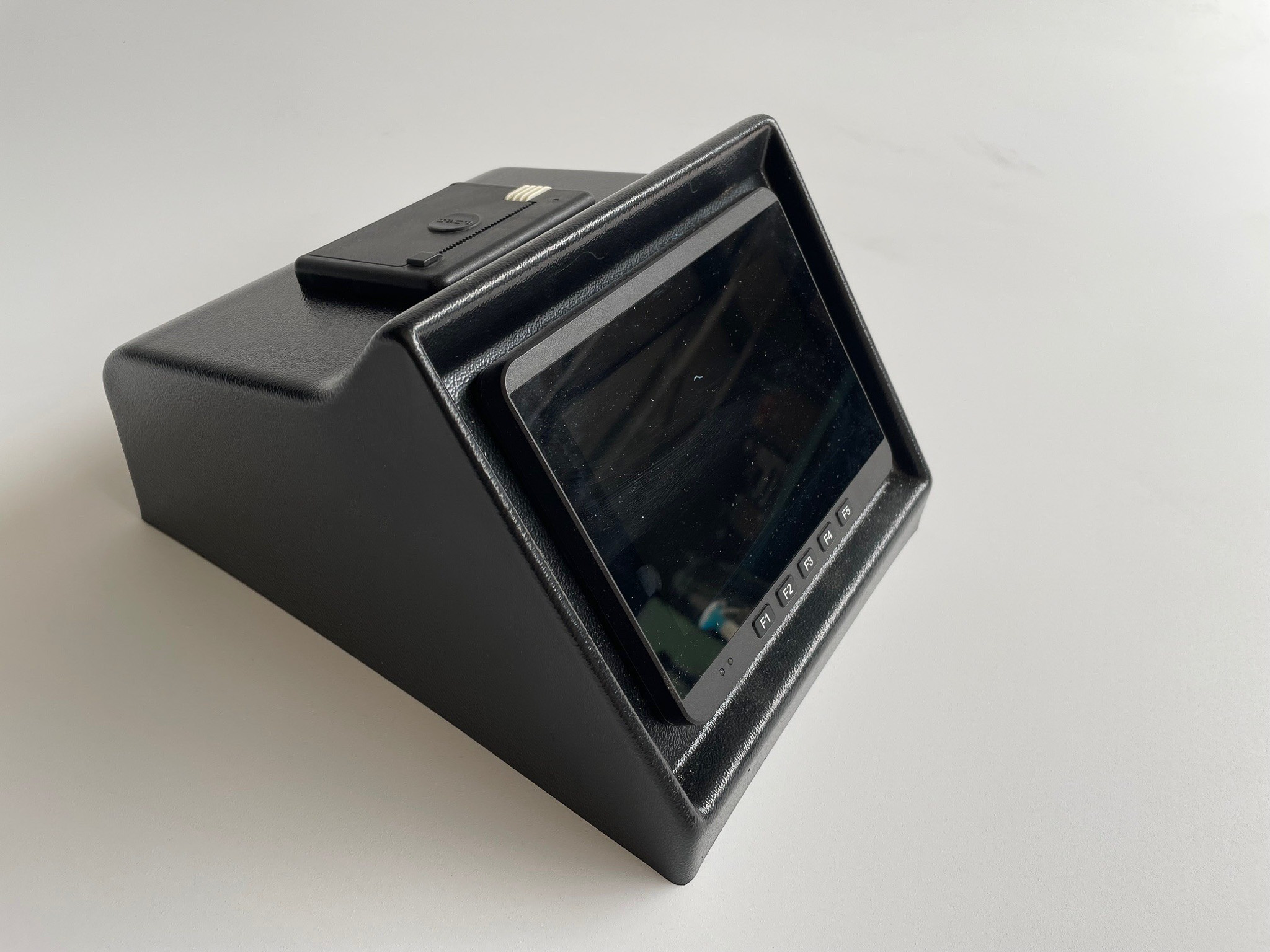
Plastic sheet metalworking involves cutting, hot bending and assembling thermoplastic sheets to create finished technical parts. The principle is directly inspired by traditional metal sheet metalworking, with the key difference being the material worked — plastic rather than steel or aluminium.
Its main strength: it does not require a full mould. Work is carried out directly from flat sheets, which eliminates a large part of the tooling costs and makes the process accessible much earlier in a project. It is the natural solution for large parts such as covers, lids or backplane cards, whenever speed is needed without blowing the tooling budget.
Materials used
Plastic sheet metalworking uses thermoplastic sheets — materials that soften under heat and can be shaped without losing their properties once cooled. The most common in our workshop:
PVC for its chemical resistance and controlled cost. HDPE for its toughness against impacts and corrosive products. PMMA (plexiglass) for its optical qualities and aesthetic finish. ABS for its ease of machining and rigidity. PC (polycarbonate) for its impact resistance and transparency. PP for its lightness and performance in humid or chemically aggressive environments.
The choice of material always depends on the project's constraints: operating temperature, chemical exposure, mechanical requirements, regulatory constraints or simply the desired final appearance.
Production techniques
Plastic sheet metalworking combines several techniques, often on the same part.
Cutting and machining open the process. Sheets are cut on CNC machining centres according to the required shapes: contours, holes, notches, openings. Tolerances achieved are in the order of one tenth of a millimetre, allowing demanding technical applications to be addressed.
Hot bending then gives the part its three-dimensional shape. The sheet is heated locally along the bending line until it softens, then bent to the desired angle. No specific tooling is required, which provides real flexibility if the design changes between runs.
Plastic welding assembles the various parts in a strong and durable way. Hot air welding is mainly used for thick assemblies, and solvent welding for molecular bonds with high resistance.
Bonding complements or replaces welding depending on the materials and mechanical constraints involved. Structural adhesives specific to thermoplastics ensure long-term hold.
Finally, finishing: spray booth painting, protective coating, engraving or marking for part identification. This is often the step that makes the difference in the final result.
Advantages of the process
The first advantage is the reduction of tooling costs. Without a full mould to design and validate, start-up costs are far more accessible and production lead times significantly shorter. This is a decisive factor for projects in the development phase or medium runs that do not justify a heavy investment.
Flexibility is the second asset: modifying a design between two runs does not generate significant additional costs. The CNC programme is adjusted, the bending jig is tweaked, and production resumes.
Finally, plastic materials bring their own benefits: lightness, corrosion resistance, electrical insulation, chemical resistance and ease of maintenance. Characteristics that metal simply cannot offer under the same conditions.
Sectors of application
The industrial, medical and defence sectors are the most demanding. In industry, plastic sheet metalworking is used to manufacture machine covers, protective housings, trays and workshop equipment resistant to aggressive environments. In the medical field, it meets needs for laboratory machine cladding and cartridge parts with strict requirements for cleanliness and chemical resistance. In defence, constraints of robustness, lightness and performance under extreme conditions make thermoformed plastic a material of choice.
The food industry is also an active sector, with parts that must withstand frequent washing and aggressive cleaning products. The energy and environment sector finds solutions for tanks, retention trays or protective elements. Visual communication and POS also use these techniques for lightweight, aesthetic and cost-effectively customisable parts.
Plastic sheet metalworking and Plastisart
At Plastisart, plastic sheet metalworking has been a core part of our offering for decades. Our workshop is equipped with 3 and 5-axis machining centres, hot bending tools, hot air plastic welding stations and a spray booth for finishing. Our in-house design office supports every project from the design stage to ensure technical feasibility, the right material choice and compliance with required tolerances.
Prototype or series, simple part or multi-material assembly: our teams are here to turn your project into a real part, on time and within budget.
Get in touch with a team of professionals
Interested in our service? Don't hesitate to contact our team of specialists who are here to help. We are available by phone or via the online form.