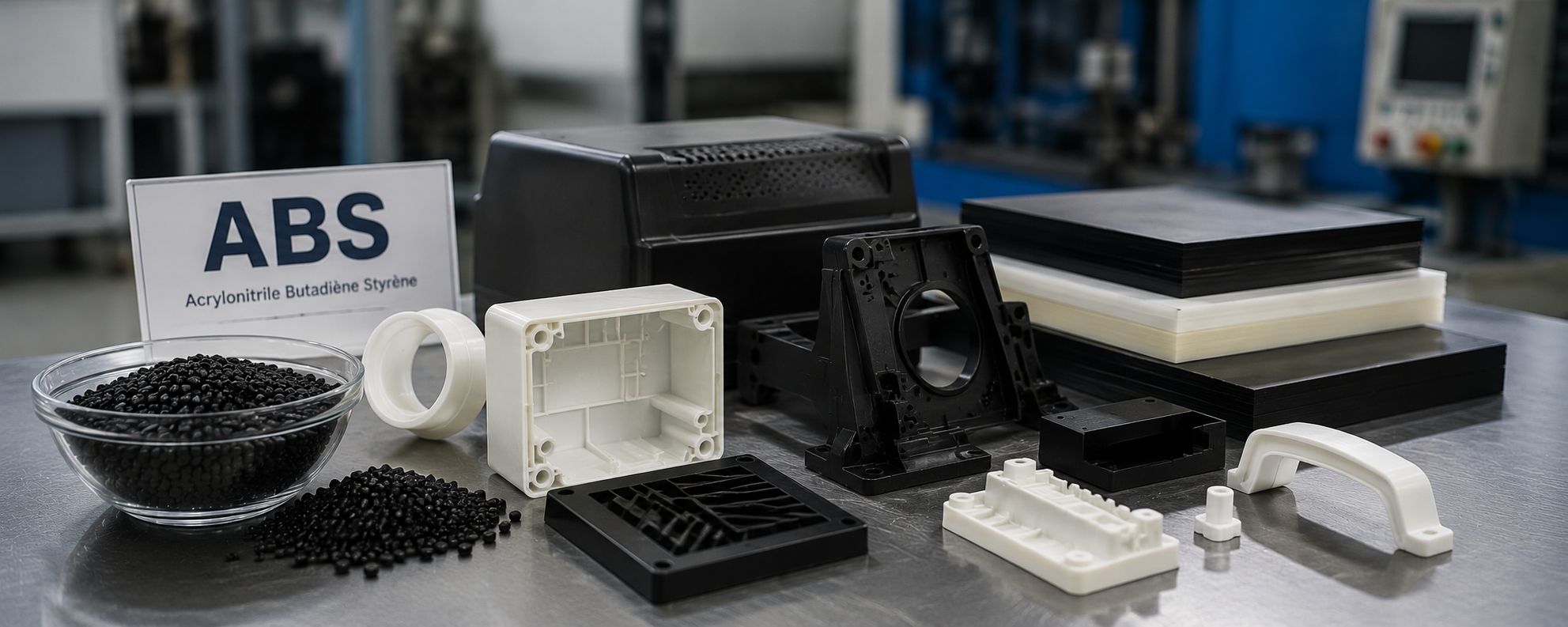
ABS is one of the most essential technical thermoplastics in industry. Recognised for its perfect balance between robustness, aesthetics and ease of processing, it is the material of choice for covers, industrial housings and parts requiring high mechanical strength.
A material with recognized balance
- Comprehensive support, from design to industrialization
- Detailed identification of your technical needs
- Advice on the choice of the most suitable technologies
What is ABS plastic?
Acrylonitrile Butadiene Styrene (ABS) is an amorphous thermoplastic polymer. Its great strength lies in its chemical formulation, which combines the properties of three distinct monomers to create a material with exceptional characteristics:
- Acrylonitrile: provides rigidity, chemical resistance and thermal stability.
- Butadiene: an elastomer that gives ABS its legendary impact resistance, even at low temperatures.
- Styrene: guarantees a fine surface finish (gloss or matt appearance) and excellent machinability and formability.
The main properties and advantages of ABS
ABS is particularly valued by design offices because it offers a very advantageous technical and economic compromise:
- Mechanical properties: very high impact resistance (shocks, drops), excellent rigidity and good dimensional stability. It is a lightweight material that does not deform easily.
- Thermal properties: it withstands service temperatures ranging from -20 °C to +80 °C.
- Aesthetic properties: it offers a high-quality surface finish and is available in many finishes (smooth, gloss, matt, textured). It is easily mass-coloured or paintable.
- Economic advantage: it offers an excellent quality/price ratio compared to other more expensive technical plastics such as polycarbonate.
The limitations of ABS: which applications should it be avoided for?
As experts, it is our duty to guide you towards the right material. ABS has certain limitations to be aware of:
- UV sensitivity: in its standard version, ABS tends to yellow and weaken if exposed to sunlight for extended periods. For outdoor use, we will direct you towards UV-treated ABS or ABS/PMMA which benefits from an acrylic protective layer.
- Low solvent resistance: it is sensitive to strong solvents (ketones, esters, aromatic hydrocarbons). It is not suited to chemical tanks.
- Food contact: standard ABS grades are generally not certified for direct food contact (unlike HDPE or PETG).
How does Plastisart process ABS?
ABS has the advantage of being one of the most "docile" plastics to process. At Plastisart, we work with it daily through different processes:
- Vacuum thermoforming: ABS is ideal for thermoforming. It stretches homogeneously, perfectly reproduces the finest mould details (ribs, textures) and shows low shrinkage on cooling.
- CNC machining: it is milled, turned and drilled with great precision. It generates clean chips without melting or clogging tools, allowing very tight dimensional tolerances.
- Hot bending: ABS bends very well for producing angular housings or brackets without requiring a mould.
- Assembly and finishing: it is a plastic that bonds perfectly (solvent or structural bonding) and forms an excellent adhesion base for our painting (coating) and marking operations.
Industry sectors and typical industrial applications
Thanks to its resilience and attractive appearance, ABS is found in many sectors for the manufacture of:
- Covers and protective housings for industrial machines
- Electronic and electrical housings and payment terminals
- Interior cladding parts for transport (trains, buses, special vehicles)
- Robust handling trays
- Safety helmet shells and construction site protections
Industrial sector
Covers, protective housings and control enclosures for industrial machines and production equipment.
Medical & pharmaceutical sector
Medical equipment housings and enclosures in flame-retardant ABS with refined finishes and full traceability.
Aerospace & defence sector
Protective shells and technical claddings in high-performance ABS for defence equipment.
Transport & mobility sector
Interior cladding parts for trains, buses and special vehicles in impact-resistant ABS.
Food processing sector
Claddings and protections for processing equipment in ABS resistant to industrial cleaning.
Communication & events sector
Display units, totems and signage structures in ABS with RAL/Pantone coating in your brand colours.
Cosmetics sector
Aesthetic shells and housings in ABS with textured or smooth surfaces and high-end finishes.
Office sector
Terminal housings, control fascias and self-service kiosks in flame-retardant ABS UL94 V0.
Building & construction sector
Electrical enclosures and protections for technical equipment in building installations.
Energy & environment sector
Charging point claddings and energy equipment housings in UV-stabilised ABS.
Sports & leisure sector
Safety helmet shells, construction site protections and fairings for motorised sports equipment.
Why choose Plastisart for your ABS parts?
Processing ABS requires mastery of temperatures (to avoid whitening during bending) and dimensional shrinkage (in thermoforming). At Plastisart, you benefit from a permanent stock of ABS sheets (various thicknesses, textured or smooth finishes) for maximum responsiveness. Our integrated design office validates your drawings and delivers complete sub-assemblies, machined, assembled and painted, ready to be fitted to your production lines.
FAQ about ABS
What is the difference between ABS and polycarbonate (PC)?
Polycarbonate is far more resistant to extreme impacts and offers optical transparency (something ABS cannot, as ABS is naturally opaque). On the other hand, ABS is significantly more economical, easier to thermoform and offers a wider choice of surface textures (graining).
Can an ABS part be painted or screen-printed?
Yes, ABS offers excellent surface tension. It bonds very well to industrial paints, varnishes and inks. It is one of the best thermoplastics if your part requires coating in your brand's colours (RAL/Pantone).
Is ABS recyclable?
Yes, ABS is a 100% recyclable thermoplastic. The machining off-cuts and trimming waste generated in our workshops are ground up and reintegrated into new production cycles.