- A plastic component that is deteriorating?
- Your original parts supplier no longer exists?
- The mould no longer exists or has been destroyed?
- The drawings for your parts cannot be found?
- Your machine is at a standstill and purchasing a new one is not an option?
This is exactly the kind of situation for which Plastisart offers a reverse engineering service integrated into its production workshops. Starting from an existing part, even a damaged one, we reconstruct the complete digital model and relaunch manufacturing using the materials and processes best suited to your application.
A broken part, no drawings, no CAD file? That is not an obstacle. It is our starting point.
Parts reproduction
- Comprehensive support, from design to industrialization
- Detailed identification of your technical needs
- Advice on the choice of the most suitable technologies
Our reverse engineering process in 5 steps
Part analysis and needs assessment
You send us the part to be reproduced, along with its operating constraints: environment, mechanical or thermal stresses, desired material, target quantities. This analysis phase allows us to steer the project towards the most appropriate scanning technique and manufacturing process.
3D scanning and data capture
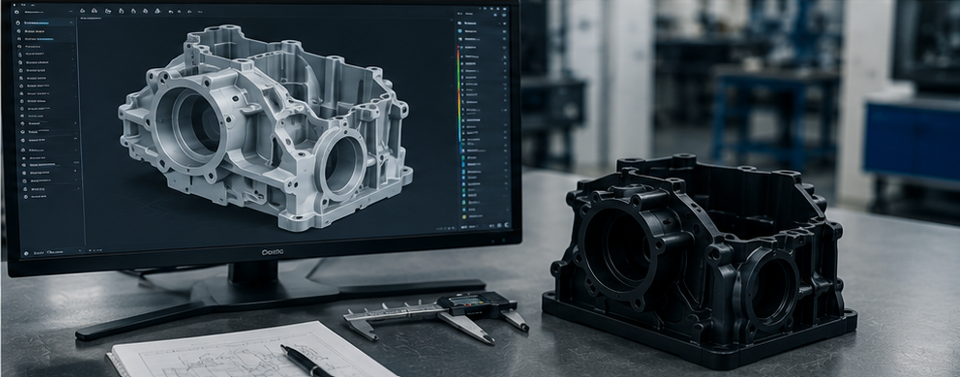
We scan the part using 3D scanning technology. This allows us to capture the complete geometry of the part with precision, including more complex shapes, surfaces and fine details. From this, we obtain a point cloud or 3D mesh that serves as the basis for modelling.
CAD modelling
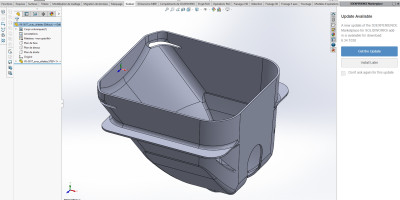
The scan data is reworked by our design office technicians to produce a CAD model usable in manufacturing. This step is not limited to a simple conversion of the scan file: it is a reconstruction that takes into account the constraints of the chosen manufacturing process. If improvements are desired, they are integrated at this stage.
Project validation
The 3D model and execution drawings are submitted for validation before launch. We can produce a control 3D prototype to verify dimensions and adjustments in your operating environment.
Manufacturing and delivery
The part is produced in our workshops using the process best suited to its geometry, material and your volume: CNC machining 3 or 5 axes, thermoforming, RIM injection, blow moulding, bonding, welding. The CAD file produced belongs to you and you can use it subsequently.
When to call on plastic reverse engineering?
Some typical situations encountered in our projects:
- A cladding or protection part on an industrial machine is no longer available from the original manufacturer
- The part model never existed in digital form — it had been designed directly into tooling
- A subcontractor has closed and the files are no longer available
- A part is still functioning but is beginning to show signs of wear
- You need to adapt an existing part to a new version of your product without starting from scratch
In all these cases, reverse engineering avoids the most costly alternative: the complete redesign of the component, with its associated delays and investments.
Why trust Plastisart for plastic reverse engineering?
Entrusting the reverse engineering of a plastic part to a provider specialised solely in digitisation often only solves part of the problem. You obtain a CAD file, but you then need to find a manufacturer capable of producing the part in the right material, with the right process, within the desired timeframes.
At Plastisart, both phases are managed by the same team, in the same workshops. Our design office reconstructs the CAD model taking manufacturing constraints into account from the outset. The scanned part becomes a produced part, without file transfers between providers, without loss of information and without additional delays.
Our different sectors of activity
Industrial Sector
Machine guards, equipment protections and structural parts for demanding industrial environments.
Medical & Health Sector
Covers, protections and transparent parts for medical equipment in cleanrooms or operating theatres.
Aerospace & Defense Sector
Canopies, optical curves and lightweight parts for aeronautical and defence applications.
Automotive & Transport Sector
Windscreens for special vehicles, cabin glazing and visual protections for transport equipment.
Agri-food Sector
Parts in food-grade materials (PETG, PMMA) adapted to hygiene and cleaning requirements.
Communication & Events Sector
Displays, domes and curved visual elements for stands, exhibitions and event signage.
Cosmetics Sector
Curved aesthetic parts for premium packaging and presentation displays.
Office & Business Sector
Protections, dividers and ergonomic curved parts for office furniture and equipment.
Building & Construction Sector
Architectural curves, glazing and decorative plastic elements for the construction sector.
Energy & Environment Sector
Curved covers and protections for energy installations and environmental equipment.
Sports & Leisure Sector
Transparent or tinted parts for sports equipment, leisure vehicles and visual protections.
FAQ
What is plastic part reverse engineering?
Reverse engineering consists of analysing an existing physical part to reconstruct its geometry, dimensional characteristics and manufacturing specifications, without having the original documents. Applied to industrial plastic parts, it allows several types of needs to be met: reproducing an obsolete component, replacing a worn or broken part, adapting an existing part to new constraints, modernising a component, or building a digital file of critical parts to secure future supplies.
What materials are available for part reproduction?
Our mastery of technical thermoplastics allows us to reproduce your parts in the same materials as the original, or in materials with superior performance if your specifications require it. We work in particular with: ABS, HDPE, POM, PA, PEEK, PTFE, PMMA, PC, PVC, PP, and their filled or reinforced variants. The choice of replacement material is an integral part of our initial analysis. An identical reproduction is not always the best solution and sometimes a material change can significantly extend the service life of the part.
Can you scan and reproduce a part that is broken or incomplete?
Yes, absolutely. A damaged part is our usual starting point. During the CAD modelling phase, our design office virtually repairs the 3D mesh from the scan to reconstruct the missing volumes, correct wear deformations and restore the part to its original functional geometry.
Does the CAD file from reverse engineering belong to you?
Yes, the 3D digital file produced by our design office belongs to you entirely at the end of the project. We provide it to you so that you can secure your future supplies and build your own catalogue of critical parts.
What is the advantage of entrusting this service to Plastisart rather than a simple scanning provider?
A scanning specialist only delivers a computer file. At Plastisart, we manage the complete chain under one roof: we scan, we model by directly integrating industrial constraints, and we immediately manufacture your part (machining, thermoforming, RIM). You avoid intermediaries, data loss and additional delays.