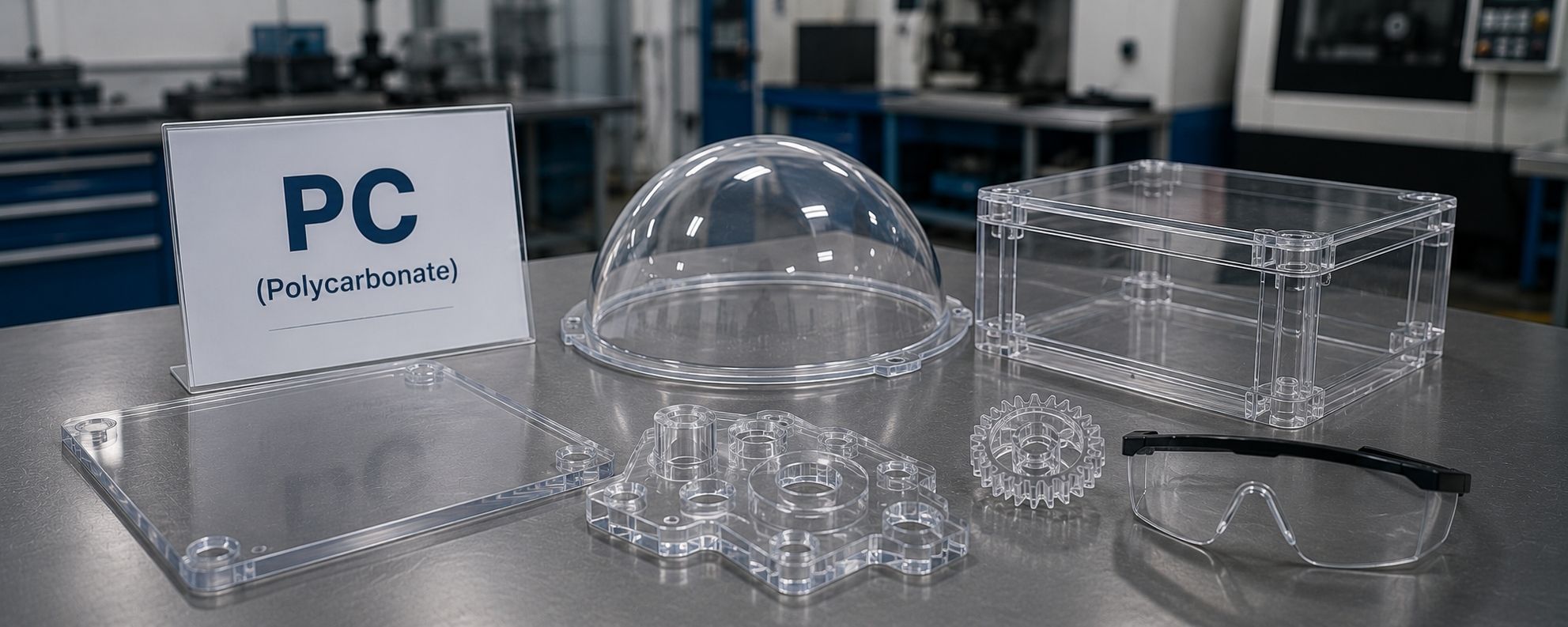
If only one characteristic of polycarbonate (PC) were to be remembered, it would be its spectacular robustness. Often described as an "unbreakable" plastic, it offers a unique combination: the transparency of glass allied with extraordinary impact resistance. It is the material of choice for industrials in all applications where safety and visibility are absolute imperatives.
Toughness that can take anything
- Comprehensive support, from design to industrialization
- Detailed identification of your technical needs
- Advice on the choice of the most suitable technologies
What is polycarbonate (PC) plastic?
Polycarbonate is a technical thermoplastic polymer from the amorphous family. Developed for demanding applications, it stands out for the exceptional strength of its molecular bonds (the carbonate groups). It is this specific structure that gives it the ability to absorb violent impacts without breaking or shattering. Although it exists in opaque form (often alloyed with ABS), its purest and most sought-after form in industry is the transparent sheet.
The main properties and advantages of PC
Polycarbonate is the material design offices turn to when mechanical and thermal constraints become critical:
- Unrivalled impact resistance: PC is approximately 250 times more impact-resistant than standard glass and 30 times more than PMMA (Plexiglas). It absorbs impacts, blows and vandalism without breaking.
- High thermal resistance: it retains its mechanical properties over a very wide temperature range, from -40 °C to +120 °C (even 130 °C for certain grades), where ABS or PMMA begin to deform.
- Excellent optical transparency: in its natural state, PC transmits up to 88% of visible light, offering excellent visibility.
- Dimensional stability: its very low moisture absorption rate and rigidity allow it to maintain precise tolerances, even in demanding environments.
The limitations of polycarbonate: which applications should it be avoided for?
Our expertise also involves warning you of the material's weak points to guarantee the longevity of your parts:
- Low scratch resistance: paradoxically, although it is unbreakable, PC has a relatively soft surface. It scratches easily under abrasion. We can direct you towards PC sheets coated with an "anti-abrasion / hard-coated" surface treatment.
- UV sensitivity (yellowing): standard PC exposed outdoors over time will yellow and become opaque under sunlight. For outdoor glazing, it is essential to use a UV-treated PC grade (generally co-extruded).
- Chemical sensitivity and stress cracking: PC is attacked by solvents, aggressive machining oils and certain alkaline products. Poor cleaning or inappropriate machining can cause microcracks (crazing) if the part is under stress.
How does Plastisart process polycarbonate?
Polycarbonate is a demanding material requiring specific expertise, particularly regarding moisture management and internal stresses. At Plastisart, we process it through:
- CNC machining and milling: PC machines very well with tight tolerances. Our technicians use specific cutting speeds and tools to avoid overheating the material and guarantee clean edges without creating microcracks.
- Cold and hot bending: unusually for a transparent plastic, PC can be cold-bent (on thin thicknesses) thanks to its extraordinary ductility. For more complex geometries or thick sections, we use hot bending on a heating line.
- Thermoforming and draping: PC is hygroscopic (it absorbs moisture from the air). To thermoform it, we must mandatorily oven-dry (pre-dry) the sheets for several hours to prevent bubbles from appearing during heating and to guarantee a perfect finished part.
- Bonding and assembly: we assemble PC using suitable two-component or structural adhesives to guarantee robust housings or glazing.
Industry sectors and typical industrial applications
PC is the standard answer to the question "How do you protect people and machines while maintaining visibility?":
- Protective guards for machine tools, safety portholes, transparent anti-splatter covers
- Anti-riot shields, safety glazing, protective visors
- Incubators, medical device housings, sterilisable transparent tanks
- Electronic housings, transparent covers, insulating components
Industrial sector
Protective guards for machine tools, safety portholes and transparent anti-splatter covers for demanding industrial environments.
Medical & pharmaceutical sector
Incubators, medical device housings and sterilisable transparent tanks in Medical Grade PC certified USP Class VI.
Aerospace & defence sector
Anti-riot shields, armoured safety glazing and protective visors in PC resistant to extreme impacts.
Transport & mobility sector
Safety glazing, portholes and transparent protections for special vehicles and public transport.
Food processing sector
Transparent protections and safety covers for production lines with PC grades compliant with hygiene standards.
Communication & events sector
Vandal-resistant display cases and outdoor signage structures in UV-stabilised PC resistant to weathering.
Cosmetics sector
Robust transparent housings and covers for dispensers and cosmetic packaging equipment.
Office sector
Electronic housings, transparent covers and insulating components for work equipment and terminals.
Building & construction sector
Skylights, roof domes and impact-resistant protective glazing in PC for outdoor structures.
Energy & environment sector
Transparent covers and protections for measuring equipment and charging points resistant to weathering.
Sports & leisure sector
Helmet visors, transparent protections and cockpit glazing for sports and marine equipment.
Why choose Plastisart for your polycarbonate parts?
Polycarbonate does not forgive amateurism, particularly in thermoforming (oven-drying management) or machining (stress management). Our design office has perfect mastery of this polymer's specificities. From oven-drying the material before processing to selecting the right surface treatment (anti-scratch, anti-UV), we integrate every step in our workshops to deliver parts of absolute safety and clarity.
FAQ about polycarbonate (PC)
Polycarbonate or PMMA (Plexiglas): how to choose?
The rule is simple for industrials: if your absolute priority is safety against impacts (risk of breakage, part projection), choose polycarbonate. If your priority is perfect optical quality and scratch resistance (aesthetics, point-of-sale displays, showcases), go for PMMA.
Can polycarbonate be used for food or medical applications?
Standard PC contains Bisphenol A (BPA), which restricts its use in direct food contact under many regulations. However, specific "Medical Grade" polycarbonate grades certified ISO 10993 or USP Class VI exist, capable of withstanding repeated steam sterilisation (autoclave), highly valued for medical devices.
Can polycarbonate be laser cut?
Unlike PMMA, polycarbonate reacts poorly to CO2 laser cutting. The intense heat of the laser tends to burn the material, melt the edges and leave carbonised edges (yellow or brown) while creating strong internal stresses. At Plastisart, we always prefer mechanical cutting (CNC machining) for PC to guarantee perfect edges and a part free from brittleness.