In plastic transformation, the quality of a part begins long before production. It begins with the tooling. A poorly designed thermoforming or RIM injection mould, approximate tolerances, a geometry that does not account for the transformation process: all of these are sources of non-conformities, reworking and accumulating delays.
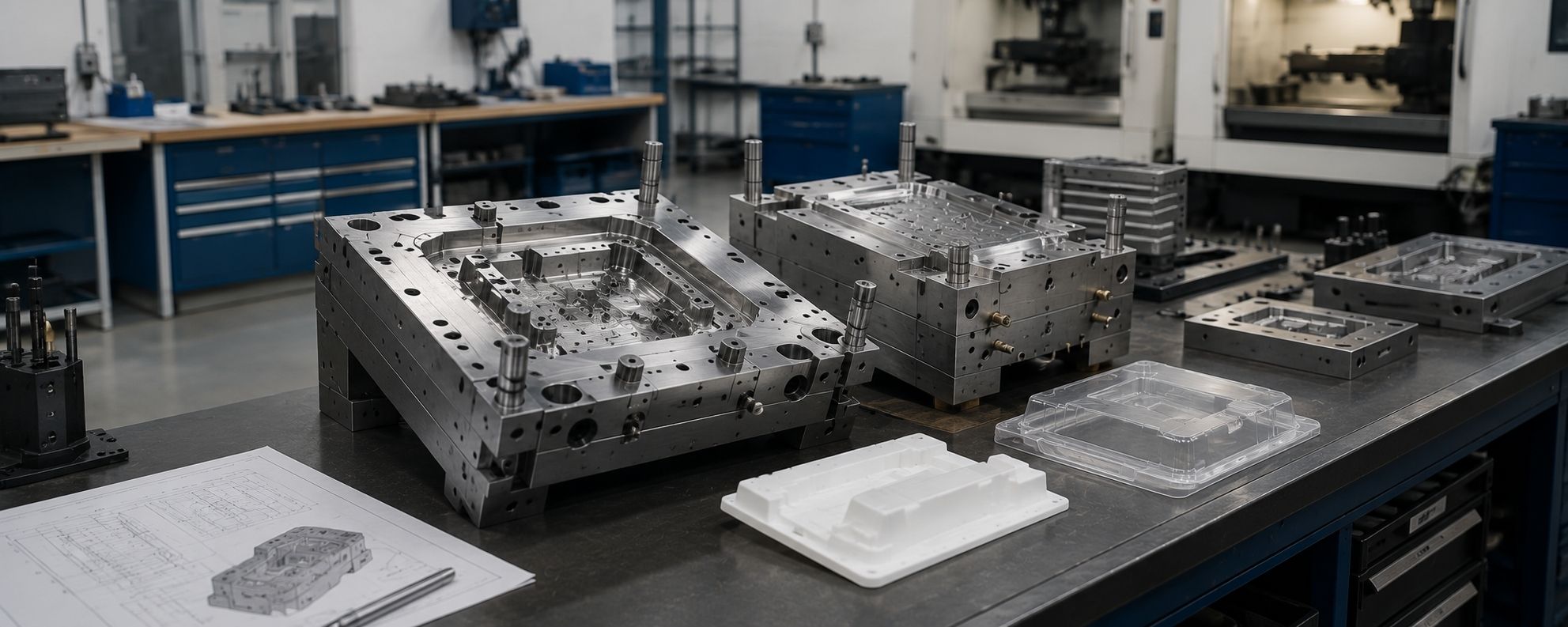
At Plastisart, tooling design and manufacture are carried out in-house, in our integrated mechanical workshop. Thermoforming moulds, RIM injection tooling, assembly jigs, cutting and bending tools: every piece of tooling is designed by our technicians, manufactured in our workshops and validated on our production machines. This closed-loop operation guarantees complete consistency between the tool and the process, and removes the delays and risks associated with outsourcing tooling.
The mold: the key piece of a successful project
- Comprehensive support, from design to industrialization
- Detailed identification of your technical needs
- Advice on the choice of the most suitable technologies
Why tooling is a strategic step
Tooling directly determines the quality of the parts produced, the repeatability of the series and manufacturing costs. A thermoforming mould, for example, determines the draft angles, radii, dimensional tolerances and surface finish of every part produced. An error at this stage affects the entire series.
Entrusting tooling manufacture to an external subcontractor creates a disconnect between the design of the tool and its launch into production. Adjustments are often needed once the tool is received, generating back-and-forth, delays and unforeseen costs. At Plastisart, this disconnect does not exist, because the same team designs the tooling and produces the parts.
Our tooling design and manufacturing capabilities
Integrated CAD/CAM design
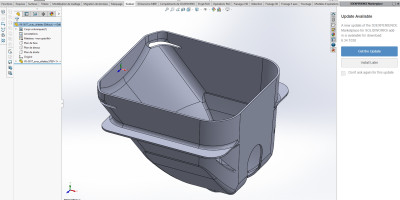
Our technicians design tooling in 3D from your drawings or CAD files, taking into account from the outset the constraints of the chosen transformation process. Every detail is anticipated: cavity geometry, draft angles, ejection systems, interfaces with production machines. CAD design is directly linked to our CAM programming, ensuring continuity between the digital file and the machined part.
Manufacturing in our mechanical workshop
Our 3 and 5-axis machining centres allow us to produce high-precision tooling in a wide range of materials: aluminium for prototype tooling and small series, steel for production tooling with a longer service life. In-house manufacturing allows us to control every step, adjust quickly in the event of specification changes and meet controlled lead times.
Tooling for thermoforming
Designing thermoforming moulds requires specific expertise: managing draft angles, sizing vacuum systems, accounting for material shrinkage depending on the thermoplastic used. Our experience in thermoforming, Plastisart's historic process, allows us to design tooling perfectly suited to our machines and the materials we process.
Tooling for RIM injection
RIM (Reaction Injection Moulding) uses low-pressure moulds, generally made of aluminium or resin, suited to small and medium series. We design and manufacture this tooling in-house, allowing us to control production lead times and quickly adapt the geometry if needed.
Assembly jigs and fixtures
Beyond transformation moulds, our mechanical workshop also produces positioning jigs, bonding and welding fixtures, and dimensional inspection tools used on our production lines. This secondary tooling is just as decisive for the final quality of the sub-assemblies we deliver.
Maintenance, modification and adaptation of tooling
Production tooling must be maintained, modified in the event of product changes, and repaired quickly in the event of failure. Our mechanical workshop provides complete maintenance of tooling in production: cleaning, cavity rectification, replacement of wear parts, dimensional adjustments.
When a client's product evolves, whether through a new dimension, a material change or an adaptation to a modified assembly requirement, we work directly on the existing tooling rather than starting a new tool from scratch. This rapid modification capability is an important lever for our clients managing regular product evolution cycles.
The added value of tooling designed by the manufacturer
Having your tooling manufactured by a third party and then entrusting production to a plastics processor multiplies the points of contact and the risks of incompatibility. The tool arrives at the workshop, and it sometimes turns out not to be perfectly suited to the processor's machines, materials or production parameters. Adjustments take time and generate unforeseen costs.
At Plastisart, tooling is designed by the people who will use it, on the machines that will produce your parts and with the materials that will be processed. This consistency between the tool and the process is what guarantees a fast production launch, compliant parts from the first series and an optimal tooling lifespan.
Our different sectors
Industrial sector
Tooling for machine covers, equipment protections and structural parts for demanding industrial environments.
Medical & pharmaceutical sector
Moulds and jigs for precision parts in cleanrooms, with material traceability and complete regulatory documentation.
Aerospace & defence sector
High-precision tooling for lightweight and technical parts subject to enhanced traceability requirements.
Transport & mobility sector
Moulds for special vehicle claddings, protective housings and large-dimension structural parts.
Food processing sector
Tooling compliant with hygiene requirements for food-contact parts, with certification of the materials used.
Communication & events sector
Moulds for display units, domes and curved visual elements with a refined surface finish.
Cosmetics sector
Premium tooling for shells and aesthetic elements with high perceived value destined for luxury packaging.
Office sector
Moulds for housings, control fascias and appearance parts for work equipment and terminals.
Building & construction sector
Tooling for protective glazing, roof domes and large-dimension facade elements.
Energy & environment sector
Resistant moulds for parts exposed to outdoor conditions and aggressive chemical agents.
Sports & leisure sector
Tooling for shells, fairings and transparent parts subject to lightness and impact resistance requirements.
Why trust Plastisart with your project?
Well-designed tooling means smooth production, compliant parts and controlled series costs. At Plastisart, we do not separate tooling design from part manufacturing. The two are linked, managed by the same team, in the same workshops.
FAQ
Why does Plastisart make its moulds in aluminium rather than steel?
Aluminium is the ideal material for vacuum thermoforming and RIM injection. As these two technologies operate at low pressure, the moulds undergo far less mechanical stress than in conventional thermoplastic injection. Aluminium machines faster, dissipates heat perfectly and is significantly cheaper than hardened steel, making your projects cost-effective from small and medium series onwards. For very long production runs, however, we can also design steel tooling.
How do we manage material shrinkage when designing a mould?
This is part of the expertise of our integrated design office. Each thermoplastic (ABS, polycarbonate, HDPE, etc.) shrinks differently as it cools after thermoforming or injection. Our CAD technicians precisely calculate and integrate this shrinkage coefficient directly into the dimensions of the 3D mould, so that the final part scrupulously meets the millimetre tolerances of your drawing.
What happens if a part's drawings change during the year? Does a new mould need to be made?
This is the whole advantage of our in-house mechanical workshop. If you change a dimension, add a hole or evolve the geometry of your product, we generally do not need to recreate an entire mould. Our 3 and 5-axis CNC machining centres allow us to rework, rectify or modify existing aluminium tooling within very short lead times and at lower cost.
Who owns the moulds and tooling manufactured by Plastisart?
The moulds, assembly jigs and specific tooling developed for your project are fully funded by you as part of the initial tooling costs. They therefore remain entirely your property. We provide secure storage and maintenance on our premises between each production run.
How do we ensure the maintenance and lifespan of your moulds?
Having a mechanical workshop on the same site as our production machines changes everything. We apply a strict preventive maintenance plan: after each production run, moulds are cleaned, inspected and rectified if necessary. In the event of premature wear of a cavity, our technicians intervene immediately in-house, eliminating any risk of prolonged downtime on your supply lines.