RIM injection moulding (Reaction Injection Molding) is a process little known to the general public but particularly interesting for industrials who need to produce large parts in small and medium series, without bearing the excessive tooling costs of classical thermoplastic injection.
At Plastisart, we have mastered this process for many years. It therefore forms part of our range of plastic transformation services and allows us to respond to requests where other techniques such as thermoforming are not optimal. For example, we use RIM injection for bulky parts with complex geometries, machine covers with precise contours or components with mechanical properties close to large-series injection, but produced in smaller volumes.
The principle of RIM injection moulding
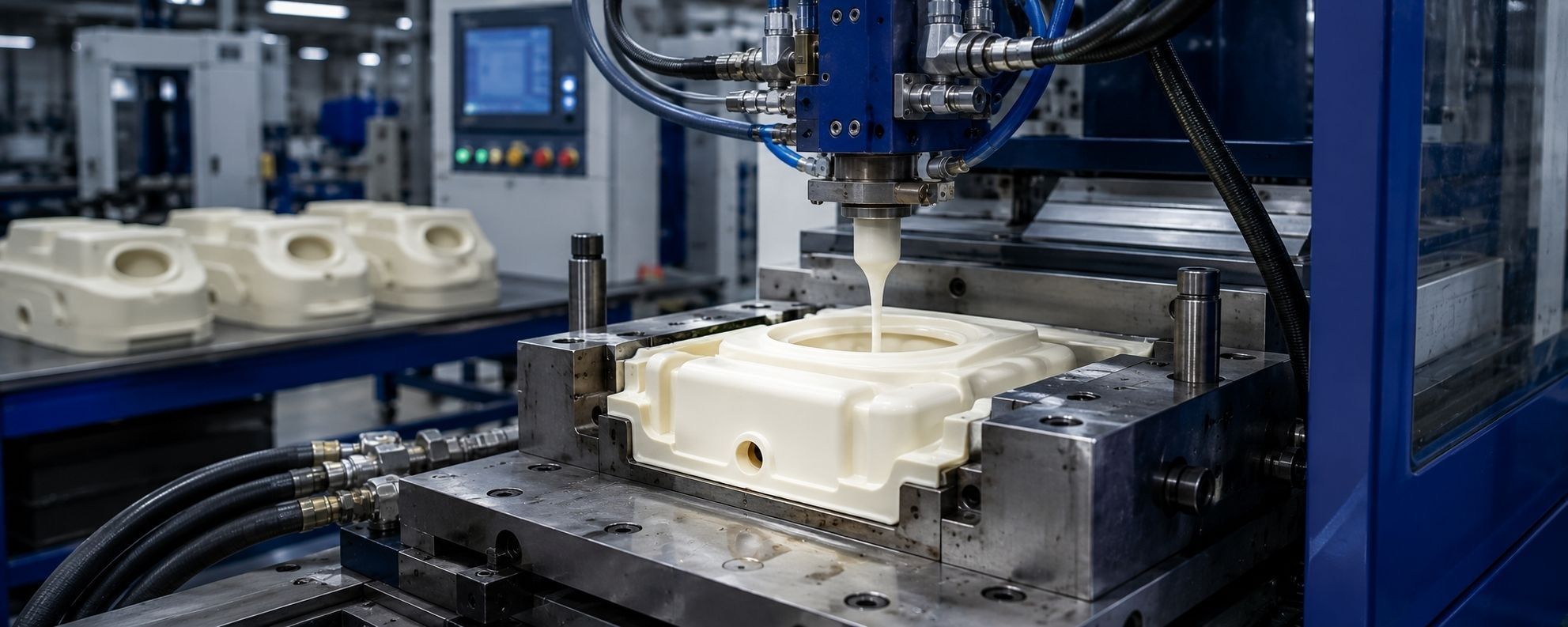
RIM injection is based on a chemical principle rather than a thermal one. Two reactive liquid components, generally a polyol and an isocyanate, are mixed under pressure in a mixing head and simultaneously injected into a closed mould. The chemical reaction between these two components produces a polyurethane polymer that takes the shape of the mould and solidifies. The injection pressure is significantly lower than in classical thermoplastic injection, which allows aluminium moulds to be used rather than hardened steel.
This low pressure is one of the fundamental characteristics of RIM and explains much of its economic advantages: less costly moulds, lighter presses, and the ability to produce very large parts without oversized equipment.
The advantages of RIM injection for industrials
Reduced tooling cost
An aluminium mould for RIM injection costs significantly less than a steel mould for classical thermoplastic injection. This difference makes RIM economically viable from the first tens of parts, whereas classical injection is only profitable from several thousand units per year.
Large dimensions accessible
RIM injection allows large parts to be produced reaching up to 1200 x 1200 mm and beyond depending on configurations. It is one of the few processes that allows machine covers, complete claddings and large-format fairings to be produced with a surface quality and dimensional precision similar to a moulding process.
Complex geometries and variable thicknesses possible
The liquid polyurethane flows freely into the mould before reacting, allowing it to reach hard-to-access areas and fill complex geometries. Thanks to this technique, it is possible to integrate certain elements directly during part design: variable wall thicknesses, ribs, overmoulded metal inserts or finer details.
Mechanical properties close to thermoplastic injection
Depending on the compositions used, RIM polyurethane parts can exhibit mechanical properties close to ABS or polycarbonate. The main properties are: impact resistance, structural rigidity and dimensional stability. We also offer fire-certified formulations (UL94 V0) for applications subject to specific regulations.
High-quality surface finishes
The aluminium moulds we use for RIM injection allow surface states close to classical injection to be achieved (smooth, textured surfaces, ready to be painted or screen-printed). At Plastisart, part finishing is directly integrated into our production process through our coating and marking workshop.
RIM vs thermoplastic injection vs thermoforming: how to choose?
These three techniques are not in competition with each other but respond to different needs.
Classical thermoplastic injection
This is the ideal process for large series. However, its steel tooling cost is high and only justifies itself from several thousand parts per year.
Thermoforming
This is an economical and fast technique for large-dimension parts and small series. It remains less suited to complex three-dimensional geometries or parts requiring significant mechanical properties.
RIM injection
It sits between the two: surface quality and mechanical properties close to injection, with tooling costs close to thermoforming, for large parts in small and medium series. It is the solution we propose when volumes do not justify investment in steel moulds but quality requirements exceed what thermoforming can offer.
At Plastisart, our design office analyses each project to direct you towards the most suitable process according to required volume, your tooling budget and your technical requirements.
Your RIM injection moulding project in 7 steps
- Specifications analysis and technical orientation
- CAD design of the part and the mould
- Manufacture of the aluminium mould in our workshop
- Production of parts by RIM injection
- Finishing operations (trimming, drilling, coating and markings according to specifications)
- Quality control (dimensional and visual) before delivery
- Delivery of your parts
Sectors and applications for RIM injection
- Covers and claddings for large-format industrial machines
- Fairings and bodywork components for special vehicles
- Housings and enclosures for medical and laboratory equipment
- Protective shells for defence equipment
- Structural components for robotics and automation
- Interior claddings for transport and mobility
Industrial sector
Machine covers, equipment claddings and large-format structural parts for demanding industrial environments.
Medical & pharmaceutical sector
Housings and enclosures for medical and laboratory equipment with refined finishes and certified mechanical properties.
Aerospace & defence sector
Protective shells and lightweight structural parts for defence equipment and aerospace applications.
Transport & mobility sector
Fairings, interior claddings and bodywork components for special vehicles and transport machinery.
Food processing sector
Claddings and protections for processing equipment with formulations compliant with hygiene requirements.
Communication & events sector
Large-format structures and display units with RAL/Pantone coating finishes directly integrated into production.
Cosmetics sector
Premium aesthetic housings and shells with smooth or textured surfaces ready for a high-end finish.
Office sector
Large-format terminal housings and control fascias with UL94 V0-certified flame-retardant formulations.
Building & construction sector
Covers and protections for technical equipment installed on or in buildings, in small and medium series.
Energy & environment sector
Housings and protective shells for large-format energy equipment exposed to outdoor conditions.
Sports & leisure sector
Large fairings and protective shells for leisure vehicles and motorised sports equipment.
The solution for large technical parts in small series
RIM injection is a solution little known to the industrials we work with. Yet it is an ideal alternative for producing parts that are too bulky for thermoforming or in too small a quantity for classical injection.
At Plastisart, we manufacture the moulds, produce the parts and finish them directly in our workshops. You therefore have a single point of contact, from drawing up the specifications to delivering the finished part.
FAQ
What is RIM injection and how does it differ from classical injection?
Classical thermoplastic injection uses heat to melt plastic granules injected under very high pressure into a steel mould. RIM injection (Reaction Injection Molding) is based on a chemical reaction: two reactive liquid components (polyol and isocyanate) are injected at low pressure into the mould, where they polymerise to form polyurethane.
Why is tooling cost much lower in RIM?
Since the fluids are injected in liquid form and at low pressure, the mould undergoes very little mechanical stress. There is therefore no need to invest in a costly hardened steel mould. We manufacture RIM moulds in aluminium, which radically reduces tooling costs and makes the process profitable from the first tens of parts.
What are the maximum dimensions for a RIM-injected part?
The low pressure allows very large-format parts to be moulded, up to 1200 x 1200 mm and beyond, without requiring monumental presses. It is the ideal process for special vehicle fairings, robot claddings or bulky covers for industrial machines.
Are RIM polyurethane parts as strong as traditionally injected plastics?
Depending on the chemical formulations selected by our design office, RIM parts display mechanical properties (structural rigidity, excellent impact resistance, dimensional stability) very close to ABS or polycarbonate. We also offer fire-certified formulations (UL94 V0 standard).
Can variable thicknesses and fine details be achieved as in classical injection?
Yes, and that is what gives RIM an immense advantage over thermoforming. The liquid mixture perfectly fills the smallest details of the mould before setting. You can design complex parts with variable wall thicknesses, integrate reinforcement ribs, fixing bosses or directly overmould metal inserts.
What type of surface finish does the RIM process offer?
The finishing level is excellent and identical to that of standard injection. On leaving the aluminium mould, the part surface can be perfectly smooth or textured according to your requirements. Parts are ready to go through our in-house coating and marking workshop to receive your RAL/Pantone shades or visual identity.