A plastic part is rarely delivered alone. It generally integrates into a sub-assembly, assembles with other components, forms a housing, a structure or a system. The quality of a plastic assembly is as decisive as the quality of the part itself: a fragile weld joint or a poorly prepared bond compromises the whole, regardless of the quality of the individual components.
At Plastisart, plastic welding and structural bonding are techniques we have mastered for decades. We use them daily in our production of parts and sub-assemblies. We also offer them as standalone services for industrials who need plastic components assembled with an industrial level of quality and traceability.
Plastic welding: assembly by material fusion
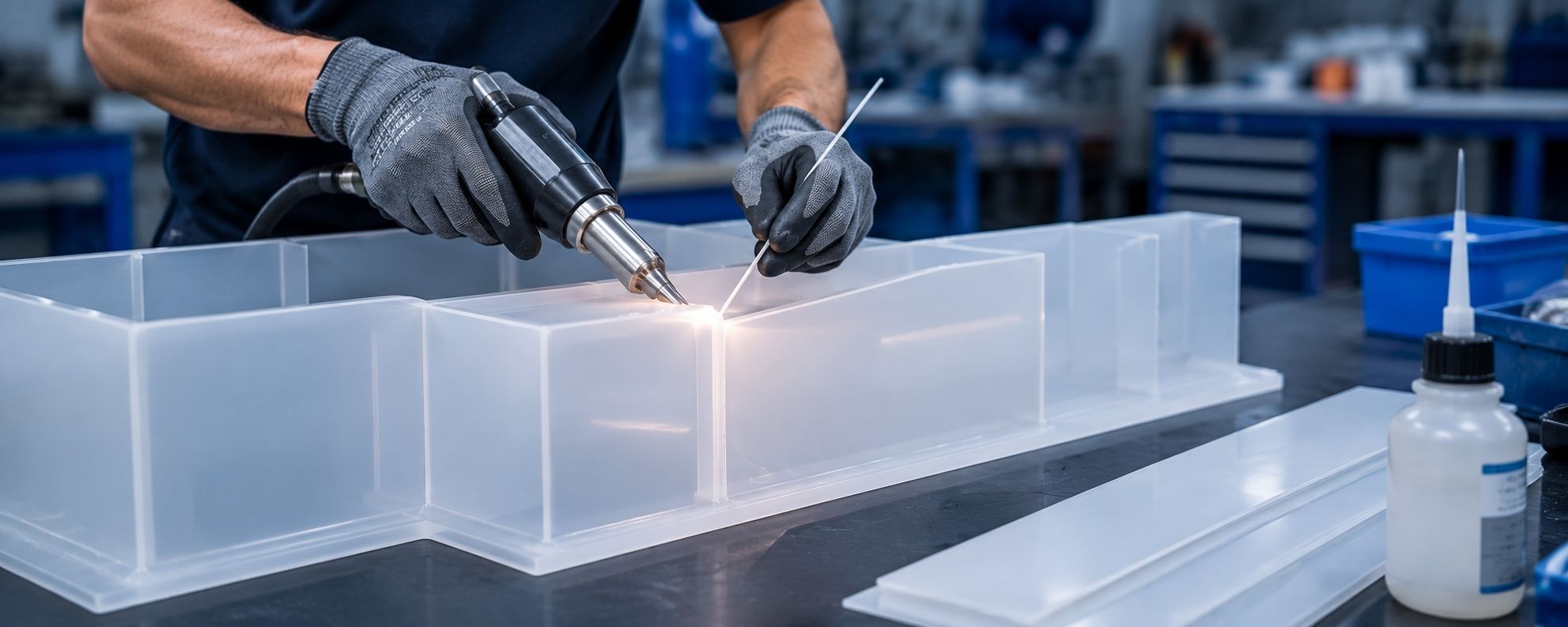
Plastic welding consists of locally bringing the surfaces to be assembled to their melting temperature, then joining them under pressure to create a continuous molecular bond between the two parts. Unlike bonding, welding does not involve a third-party product: the material itself welds to itself. The result is a joint whose mechanical strength can approach that of the base material, and which is naturally tight.
Plastic welding is applicable only to thermoplastics. It is particularly suited to plastic fabrication parts (tanks, vats, reservoirs, ducts) where tightness and resistance to mechanical stresses are a priority.
Hot air welding with rod
This process uses a hot air flow to simultaneously bring the surfaces to be assembled and a rod of the same material to their melting temperature. The melted rod is deposited in the joint and forms the weld bead as it solidifies. This technique is suited to thick assemblies, long welds and complex shapes. The most common materials: HDPE, PP, rigid PVC.
Extrusion welding
This technique uses a portable extruder that continuously deposits a bead of molten material directly into the joint to be welded. The flow rate and temperature are controlled to guarantee homogeneous fusion with the surfaces to be assembled. This technique is faster than rod welding and produces beads of constant quality, particularly suited to long welds on thick fabrication parts.
Contact welding
Assembly of two surfaces simultaneously brought to their melting temperature by contact with a heating element, then pressed against each other after removal of the element. The joint obtained is homogeneous and without external material input. This technique is suited to assemblies of profiles, tubes and parts with simple geometry with flat surfaces to be assembled.
Plastic bonding: assembly with structural adhesive
Bonding is the reference assembly technique for transparent thermoplastics such as PMMA (plexiglass) and polycarbonate, as well as for all assemblies where welding is not applicable: incompatible materials, geometries that do not allow access of a welding tool, or appearance constraints requiring an invisible joint.
Surface preparation, adhesive selection and polymerisation conditions are as decisive as the bonding operation itself in guaranteeing the durability of the assembly over time.
Solvent bonding
Solvent bonding is the reference method for assembling PMMA (plexiglass) and polycarbonate. The solvent locally softens the contact surfaces, which chemically weld to each other during evaporation. The result is a direct molecular bond, of total transparency on transparent materials and high mechanical strength. This technique is particularly suited to housings, display cases, covers and PMMA structures for which an invisible joint is required.
UV bonding
UV bonding uses a photopolymerisable adhesive that solidifies in a few seconds under UV radiation exposure. This technique is suited to assemblies on transparent materials allowing UV transmission, and produces a very clean joint with short cycle times. It is particularly used for assemblies of optical parts, glazing and transparent protections.
Two-component structural bonding
Two-component adhesives (epoxy or structural polyurethane) allow different materials or large surfaces to be assembled where other techniques are not applicable. Their high mechanical strength, vibration resistance and compatibility with a wide spectrum of materials make them the reference solution for multi-material assemblies and sub-assemblies subject to significant mechanical stresses.
How to choose between plastic welding and bonding
Welding is preferable when tightness is a critical requirement, when the materials are polyolefins (HDPE, PP) that lend themselves well to fusion, and when the part is subject to significant mechanical or chemical stresses in an aggressive industrial environment.
Bonding is preferable when the materials are transparent and the optical quality of the joint must be preserved, when the surfaces to be assembled are large, when the materials to be assembled are different, or when the geometry of the part does not allow access of a welding tool.
At Plastisart, this choice is made during the study phase by our in-house design office, taking into account the constraints of the specifications. We can also combine both techniques on the same sub-assembly when the assembly configuration justifies it.
Surface preparation and quality control
The quality of a plastic assembly begins with surface preparation. Any contamination, moisture or surface irregularity can compromise the bond strength. At Plastisart, surface preparation before welding or bonding is a formalised and systematic step: cleaning, degreasing, surface condition verification, application of bonding primers if necessary depending on the material and adhesive.
Each assembly is subject to quality control with a visual inspection and, depending on the requirements of the specifications, a functional tightness or mechanical strength test. The traceability of materials and assembly operations is maintained for each delivered batch.
Sectors and applications of plastic welding and bonding
Plastic welding and bonding at Plastisart apply to varied applications:
- Retention tanks and welded vats in HDPE or PP for industry and food processing
- Housings and display cases in bonded PMMA for display and presentation
- Multi-component sub-assemblies for industrial machinery
- Protective structures and claddings for special vehicles
- Medical and laboratory equipment requiring clean and traceable assemblies
Industrial sector
Welded vats and tanks in HDPE or PP, multi-component sub-assemblies and assembled structures for industrial machinery.
Medical & pharmaceutical sector
Clean and traceable assemblies for medical and laboratory equipment with invisible joints in PMMA or PC.
Aerospace & defence sector
Two-component structural assemblies for protective shells and defence equipment subject to high mechanical stresses.
Transport & mobility sector
Protective structures and assembled claddings for special vehicles and railway equipment.
Food processing sector
Retention tanks and collection systems welded in HDPE or PP, compliant with the strictest hygiene standards.
Communication & events sector
Housings and display cases in bonded PMMA with completely invisible joints for display and presentation of valuable objects.
Cosmetics sector
Optical PMMA assemblies and UV bonding for premium presentation showcases with crystalline transparency.
Office sector
Two-component assemblies for terminal housings and multi-material structures for work equipment.
Building & construction sector
Welded ducts and conduits in PVC or HDPE, technical reservoirs and tight structures for building equipment.
Energy & environment sector
Water treatment vats and containment systems welded in HDPE or PVDF for chemically aggressive environments.
Sports & leisure sector
Shell and transparent protection assemblies for marine and sports equipment with tightness requirements.
Materials used in plastic welding
Polypropylene (PP)
Lightweight, impact and flexion resistant, good tensile strength and moisture resistance. Resistant to diluted acids, bases and many organic solvents. Can be attacked by chlorinated solvents.
Foamed polypropylene (Foamalux, Vikufoam)
Lightweight, rigid and good thermal insulation. Similar chemical resistance to standard polypropylene, with variations depending on formulation.
Polyethylene (HDPE, HMPE, LDPE)
Abrasion and impact resistant, flexible. HDPE is generally resistant to most acids and bases. HMPE offers even higher chemical resistance. LDPE is less resistant to certain chemical products than the other variants.
PVC (Polyvinyl Chloride)
Rigid or flexible depending on formulation, durable and adaptable. Resistant to many acids and bases, but sensitive to organic solvents. Chemical resistance varies depending on the type (rigid or flexible) and stabilising additives used.
Why choose Plastisart for this assembly stage?
Plastic welding and bonding are not accessory operations. They are an integral part of the manufacturing process and determine the final quality of the delivered sub-assembly. At Plastisart, these techniques are mastered in our workshops, integrated into our production flows and subject to the same quality requirements as all our manufacturing.
FAQ
Is a welded plastic part as strong as a one-piece part?
Yes, that is the whole principle of thermoplastic welding. Unlike bonding, welding uses no third-party product: the material is locally melted under pressure to recreate a direct molecular bond. Carried out professionally by our technicians (by rod or extrusion), the weld bead displays mechanical strength that approaches that of the original material, while being naturally tight.
How do you guarantee a completely invisible and transparent bond on Plexiglass (PMMA)?
To achieve crystalline transparency without white marks or bubbles, we use solvent bonding or UV bonding. Solvent bonding chemically fuses the surfaces together through evaporation, while UV bonding uses an ultra-clean photopolymerisable adhesive that instantly hardens under UV lamp. These methods are the absolute references for display cases, housings or optical protections.
What are the main criteria for choosing between welding and bonding?
The choice depends on materials and application. Welding is ideal for industrial polyolefins (HDPE, PP), thick sections and projects requiring extreme tightness or chemical resistance (vats, retention tanks). Bonding is essential for assembling different materials, preserving the aesthetics of transparent parts, or when the geometry of the part prevents access of a welding tool.
Why is surface preparation so critical before an assembly?
In plastics processing, the slightest trace of grease, moisture, dust or release agent can sabotage the adhesion of a bond or contaminate a weld, causing premature failure of the part. At Plastisart, we apply a strict and systematic protocol: degreasing, technical cleaning, surface condition control and application of specific bonding primers depending on the polymer used.
How do you test the compliance and tightness of your assemblies?
Each batch of assembled sub-assemblies follows our internal inspection plan. In addition to a rigorous visual inspection of joints and weld beads, we carry out, according to your specifications, functional tightness tests (essential for tanks and fabrication vats) or mechanical strength tests. All operations and material batches remain fully traceable.